
Can a police officer search your car without consent? Generally, no, but there are specific exceptions to this rule. The Fourth Amendment of the U.S. Constitution protects you from unreasonable searches and seizures. This means police officers typically need a warrant based on probable cause to search your vehicle. However, the rules surrounding vehicle searches are more relaxed than those for homes due to the mobility of cars and the potential for evidence to be destroyed or moved. Understanding your legal rights during a traffic stop is crucial.
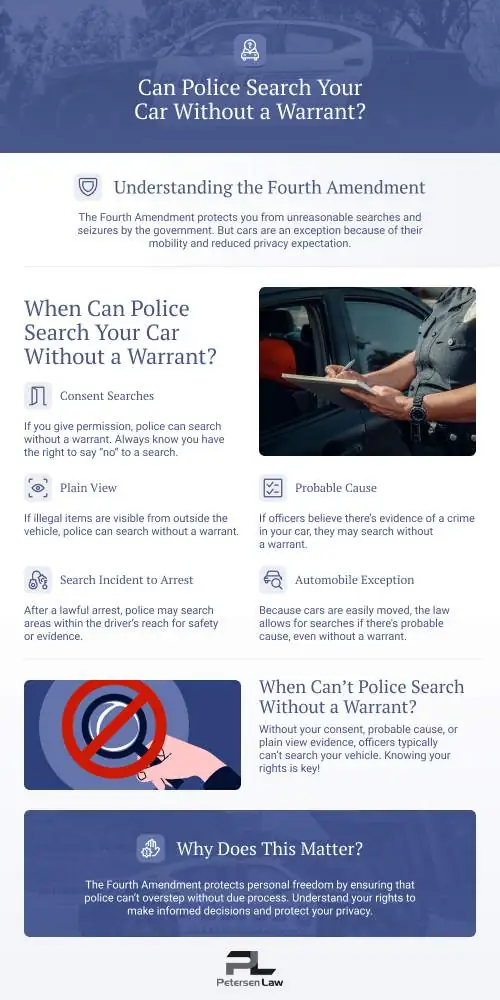
Image Source: www.criminaldefensene.com
The Fourth Amendment and Your Vehicle
The Fourth Amendment to the United States Constitution states that:
“The right of the people to be secure in their persons, houses, papers, and effects, against unreasonable searches and seizures, shall not be violated, and no Warrants shall issue, but upon probable cause, supported by Oath or affirmation, and particularly describing the place to be searched, and the persons or things to be seized.”
This fundamental protection extends to your vehicle. A vehicle search is considered a “search and seizure” under the Fourth Amendment. This means that, in most cases, law enforcement must obtain a warrant before they can legally search your car. However, the “automobile exception” to the warrant requirement is a significant area of law that often allows for a vehicle search without consent if certain conditions are met.
Warrantless Searches: When Are They Permitted?
While a warrant is the standard, several exceptions allow for a warrantless search of a vehicle. These exceptions are based on practical considerations and the unique nature of automobiles.
1. Consent to Search
The most straightforward exception is when you give consent to search. If you voluntarily agree to a search, the police can then search your vehicle.
- Voluntary Consent: Your consent must be voluntary and not coerced. If an officer asks, “May I search your car?” and you say “Yes,” that’s consent. However, if they say, “We are going to search your car,” and you don’t object, it might not be considered voluntary consent.
- Scope of Consent: You can limit the scope of your consent. For example, you can agree to a search of your trunk but not your glove compartment.
- Withdrawal of Consent: In some jurisdictions, you can withdraw consent once given, but this can be a tricky legal area.
Key Point: You are never obligated to give consent to search. If an officer asks for consent, you have the right to refuse.
2. Probable Cause and the Automobile Exception
This is perhaps the most common and complex exception. If an officer has probable cause to believe that your vehicle contains evidence of a crime, contraband, or illegal items, they can search your car without a warrant.
- What is Probable Cause? Probable cause means there is a reasonable belief, supported by facts and circumstances, that a crime has been committed or that evidence of a crime will be found in the place to be searched. It’s a higher standard than “reasonable suspicion.”
- How is Probable Cause Established?
- Plain View: If contraband or illegal items are visible from outside the vehicle, this can establish probable cause. For example, if an officer sees a bag of marijuana on the passenger seat during a traffic stop.
- Smell of Marijuana: In many states, the distinct smell of marijuana emanating from a vehicle can now be sufficient probable cause for a search, though this is evolving with marijuana legalization.
- Information from Informants: Reliable information from an informant can also contribute to probable cause.
- Officer’s Training and Experience: An officer’s professional knowledge and observations can play a role. For instance, recognizing drug paraphernalia.
- Scope of the Search: If probable cause exists, officers can search anywhere in the vehicle where the suspected contraband might be found. This includes the trunk, glove compartment, under seats, and any containers within the car that could hold the items they have probable cause to search for.
3. Search Incident to Lawful Arrest
If you are lawfully arrested while in or when exiting your vehicle, police may search your person and the passenger compartment of your vehicle.
- Purpose: This search is primarily to find weapons that you might use to resist arrest or escape, or to find evidence of the crime for which you are being arrested that might be hidden in the passenger compartment.
- Limitations: The search is generally limited to the area within your immediate control at the time of the arrest. Recent Supreme Court rulings have narrowed this exception, especially if you are already out of the car and secured.
4. Inventory Search
If your vehicle is lawfully impounded by law enforcement, they can conduct an “inventory search.”
- Purpose: This search is not to find evidence of a crime but to catalog the vehicle’s contents for safekeeping and to protect the police from claims of lost or stolen property.
- Procedure: Police must follow standardized department procedures for inventory searches. They can seize any contraband or illegal items found during this lawful inventory, and these items can be used as evidence against you.
5. Vehicle Impoundment and Towing
When a vehicle is lawfully impounded, officers can conduct an inventory search.
- Legal Impoundment: This occurs for various reasons, such as an arrestee being unable to secure the vehicle, the vehicle being involved in a crime, or the vehicle being illegally parked.
- Inventory Scope: The search must be conducted according to established departmental policy. Items found during a lawful inventory search can be used as evidence.
6. Reasonable Suspicion vs. Probable Cause
It’s important to distinguish between reasonable suspicion and probable cause.
- Reasonable Suspicion: This is a lower standard than probable cause. It means an officer has specific, articulable facts that, when combined with rational inferences, lead them to suspect that criminal activity may be afoot. Reasonable suspicion allows an officer to briefly detain you (like during a traffic stop) and ask questions. It does not generally allow for a full vehicle search without your consent or probable cause. However, reasonable suspicion can sometimes lead to probable cause. For example, if during a lawful traffic stop, an officer smells marijuana and also sees drug paraphernalia in plain view, this combination could elevate their suspicion to probable cause.
- Probable Cause: As discussed, this requires a stronger belief that evidence of a crime will be found.
7. Plain Feel Doctrine
Similar to the plain view doctrine, if an officer lawfully pats down your outer clothing for weapons and feels something that is immediately apparent as contraband (like a bag of drugs), they can seize it. This doctrine has been extended to the interior of a vehicle during a lawful stop if the officer has reasonable suspicion to believe there are weapons or contraband.
8. Exigent Circumstances
This exception applies when there is an urgent need for law enforcement to act immediately to prevent the destruction of evidence, the escape of a suspect, or danger to the public.
- Example: If an officer has probable cause to believe drugs are in a car and sees the driver about to drive away or dump the drugs, they might be justified in searching the vehicle without a warrant due to exigent circumstances.
What Happens If Your Car is Searched Illegally?
If police conduct an illegal search of your vehicle, any evidence they find as a result of that search is generally inadmissible in court under the “exclusionary rule.” This means the evidence cannot be used against you.
- The Exclusionary Rule: This rule deters police misconduct by preventing illegally obtained evidence from being used in criminal prosecutions.
- Challenging a Search: If you believe your car was searched illegally, it is crucial to consult with a criminal defense attorney. They can file a motion to suppress the evidence, arguing that the search violated your Fourth Amendment rights.
Your Rights During a Traffic Stop
When you are pulled over for a traffic stop, you have specific legal rights:
- Stay in Your Vehicle: Do not exit your vehicle unless instructed to do so by the officer.
- Be Polite and Respectful: While you don’t have to be overly friendly, being rude or confrontational can escalate the situation.
- Provide Required Documents: You are generally required to provide your driver’s license, vehicle registration, and proof of insurance.
- You Do Not Have to Consent to a Search: As mentioned, you can refuse a request to search your car.
- You Do Not Have to Answer Certain Questions: While you must identify yourself and provide requested documents, you are not required to answer questions about where you are going, where you have been, or incriminating questions, beyond what is necessary for the traffic violation. You can politely state, “I wish to remain silent.”
- Ask if You Are Free to Leave: If the officer is just issuing a ticket for a minor infraction and there’s no suspicion of other crimes, you can ask if you are free to go. If they say yes, you can leave. If they detain you further, you should ask why.
Common Scenarios and Legal Interpretations
Let’s look at some common situations:
Scenario 1: The “Sniff Test” by a K-9 Unit
- Can police use a drug-sniffing dog to “walk around” your car during a traffic stop?
- Generally, yes, if the stop is not unreasonably prolonged. The Supreme Court has held that a dog sniff around the exterior of a car during a lawful traffic stop does not constitute a “search” under the Fourth Amendment. However, the duration of the stop cannot be extended beyond what is necessary to address the initial traffic violation.
- What if the dog “alerts”?
- If the dog alerts to the presence of drugs, this alert typically establishes probable cause for the officers to search your vehicle.
Scenario 2: Finding Contraband in a Container
- If officers have probable cause to search your car for drugs, can they open closed containers within the car?
- Yes. The Supreme Court has ruled that if probable cause justifies the search of a vehicle, it justifies the search of every part of the vehicle and all containers found therein that might conceal the object of the search. For example, if officers have probable cause to believe you have cocaine, they can search a closed aspirin bottle found in your glove compartment, as cocaine could potentially fit inside.
Scenario 3: Passengers in the Car
- If an officer finds contraband on a passenger, does that give them the right to search the entire car?
- Not automatically. Finding contraband on a passenger might give the officer probable cause to search the vehicle, especially if the contraband was in a place accessible to the driver or other occupants. However, if the contraband was solely in the possession of the passenger and in a location that couldn’t implicatethe driver, it might not automatically justify a search of the entire vehicle for the driver.
Scenario 4: Driving with Tinted Windows
- If you are pulled over for a minor violation like tinted windows, can the police search your car without your consent?
- Only if they develop probable cause during the stop. The initial reason for the stop (tinted windows) does not, in itself, grant them the right to search your entire vehicle. They would need to observe something else – like the smell of marijuana, furtive movements by occupants, or contraband in plain view – to establish probable cause for a broader search.
Limitations and Evolving Law
The law regarding vehicle search is complex and constantly evolving through court decisions. What constitutes probable cause or reasonable suspicion can be interpreted differently by various courts.
- State Laws: While the Fourth Amendment sets federal standards, individual states may have laws that offer even greater protections against searches and seizures.
- Technological Advances: The use of technology, such as license plate readers and surveillance systems, also raises new legal questions about privacy and unreasonable searches.
Table: When Police Can Search Your Car Without Consent
| Exception to Warrant Requirement | Conditions for Search | Scope of Search |
|---|---|---|
| Consent to Search | You voluntarily and knowingly give permission. | Limited to the scope of consent given. |
| Probable Cause | Officer has a reasonable belief that the vehicle contains contraband or evidence of a crime. | Anywhere within the vehicle where the suspected items could be found (trunk, glove compartment, containers, etc.). |
| Search Incident to Lawful Arrest | You are lawfully arrested and the search is for weapons or evidence related to the crime of arrest, and the area searched is within your immediate control. | Passenger compartment of the vehicle. |
| Inventory Search | Vehicle is lawfully impounded and the search follows established departmental procedures to catalog contents. | All areas of the vehicle as per departmental policy. |
| Plain View | Contraband or evidence of a crime is visible from a lawful vantage point (e.g., outside the car). | The item in plain view and potentially other areas if probable cause develops. |
| Exigent Circumstances | Urgent need to act due to imminent destruction of evidence, escape of a suspect, or danger to the public. | Areas where the urgency dictates, often linked to probable cause. |
| Drug Dog Sniff | If the stop is lawful and not prolonged, and the dog “alerts” to the presence of drugs. | Based on probable cause established by the dog alert; anywhere drugs might be hidden. |
What to Do If You Believe Your Rights Were Violated
- Remain Calm and Do Not Resist: Do not physically resist a search, even if you believe it is illegal. Resisting can lead to additional charges.
- State Clearly You Do Not Consent: If asked for consent, clearly say, “I do not consent to a search of my vehicle.”
- Observe and Remember: Pay attention to everything the officers say and do. Note the time, location, and any specific actions taken.
- Do Not Lie: Honesty is important, but you are not obligated to answer questions that could incriminate you.
- Consult an Attorney Immediately: If your vehicle was searched and you believe it was done illegally, contact a criminal defense attorney as soon as possible. They are your best resource for understanding your legal rights and challenging the search.
Frequently Asked Questions (FAQ)
Q1: If I am pulled over for a broken taillight, can the police search my car?
A1: No, not automatically. The initial reason for the traffic stop (a broken taillight) is a minor infraction. The officer must have independent probable cause or reasonable suspicion that you are involved in other criminal activity before they can search your vehicle or ask for consent to search.
Q2: What if the officer asks to search my trunk, but I say no? Can they still search it?
A2: Generally, no. If you refuse consent to search, the officer needs probable cause or another exception to the warrant requirement to search the trunk. If they search without it, it would likely be considered an illegal search.
Q3: Can police search my car if it’s parked on my private driveway?
A3: The Fourth Amendment protections are strongest for your home. A car parked on your private property is generally afforded more protection than one on a public street. Police would typically need a warrant or probable cause and exigent circumstances to search a car in your driveway, though the exact boundaries can be complex.
Q4: If I am arrested for DUI, can police search my car?
A4: If you are arrested for DUI, the police may have probable cause to search your vehicle for evidence related to the DUI (e.g., open containers of alcohol, drugs). Additionally, if your car is impounded, they can conduct an inventory search. The scope of the search incident to arrest will depend on whether you were still in or near the vehicle at the time of arrest.
Q5: Does the smell of marijuana always give police probable cause to search my car?
A5: This is a rapidly changing area of law. In states where marijuana is illegal, the smell traditionally provided probable cause. However, in states where marijuana is legal for recreational or medicinal use, the smell alone may no longer be sufficient probable cause because the smell could be from a legal source. Courts are still grappling with this issue.
Your legal rights during a traffic stop and potential vehicle search are significant. Knowing these rights and the exceptions to the warrant requirement is your best defense against potential illegal search and seizure. Always remember you have the right to refuse consent to search. If you ever find yourself in a situation where your car is searched, seek legal counsel to protect your rights.