
A self-service car wash can generate significant income, with profits varying widely based on location, services offered, and operational efficiency. Typically, a self-service car wash can make anywhere from $50,000 to $200,000 in annual profit per bay. This income is influenced by factors like customer volume, the average price per wash, and the owner’s ability to control costs.
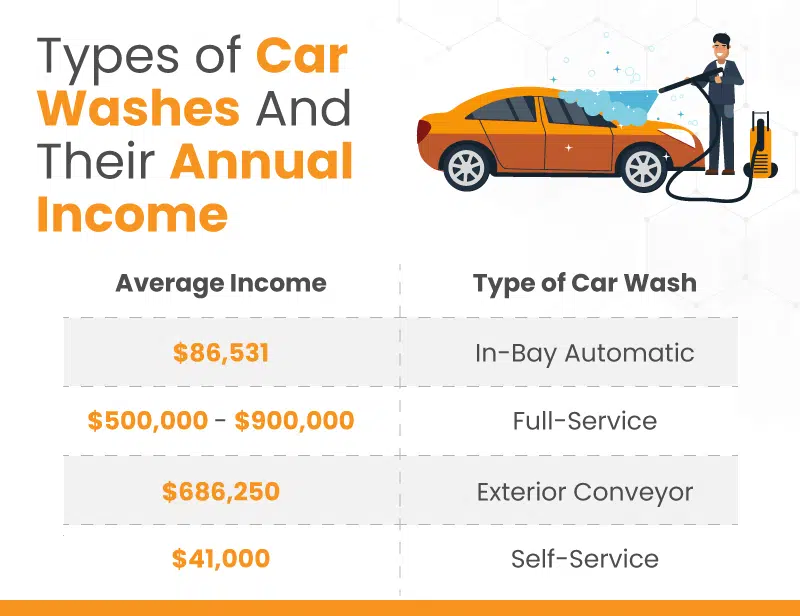
Image Source: koronapos.com
Deciphering Self-Service Car Wash Revenue Streams
The financial success of a self-service car wash hinges on multiple income sources. While the core offering is the wash bay itself, savvy operators diversify to boost overall car wash profitability.
Wash Bay Income
This is the primary driver of self-service car wash revenue. Customers pay for access to the bay and the equipment. Pricing can be time-based (e.g., per minute) or package-based (e.g., a set price for a 5-minute wash with specific functions).
- Factors influencing wash bay revenue:
- Number of bays: More bays mean more potential customers served simultaneously.
- Equipment quality and features: High-pressure water, various soap options, and effective drying can command higher prices.
- Pricing strategies: Competitive pricing, loyalty programs, and bundled deals can attract and retain customers.
- Operating hours: Longer hours, especially during peak times (weekends, evenings), increase earning potential.
- Customer volume: This is directly tied to location, marketing, and the overall appeal of the facility.
Ancillary Revenue Streams
To maximize car wash business income, owners often add supplementary services. These can significantly enhance car wash profitability.
- Vacuum Stations: A consistent earner, with many customers needing to vacuum their interiors.
- Mat Cleaners: Specialized machines to clean car mats.
- Air Freshener Dispensers: Small but profitable impulse buys.
- Towel/Chamois Vending: Offering cleaning cloths for customers.
- Pet Wash Stations: A growing niche market, attracting pet owners.
- Detailing Supplies Vending: Small items like tire shine, glass cleaner, or bug remover.
- Automatic Tire Inflators: Providing a convenient service.
- Gift Cards/Loyalty Programs: Encouraging repeat business and upfront payment.
- Advertising Space: Renting out digital screens or banner space to local businesses.
How to Calculate Car Wash Earnings: A Financial Breakdown
To accurately gauge how to calculate car wash earnings, one must consider both revenue and expenses. The difference between the two is the net profit.
Estimating Gross Revenue
Gross revenue is the total income generated before deducting any expenses.
Gross Revenue = (Average Price Per Wash × Number of Washes) + (Revenue from Ancillary Services)
Let’s break this down further:
- Average Price Per Wash: This is the average amount a customer pays for a wash. If you offer multiple packages, you’ll need to estimate the usage of each.
- Number of Washes: This is the total number of vehicles that use your facility over a period (day, week, month, year). This is a critical metric and is often the hardest to predict accurately.
- Revenue from Ancillary Services: This includes income from vacuums, vending machines, etc.
Example Calculation (Simplified):
Assume a self-service car wash with 4 bays operates for 300 days a year.
- Bays per day: 4 bays * 10 hours/day = 40 potential bay hours of operation per day.
- Average Wash Time: Let’s say an average wash cycle is 10 minutes.
- Wash cycles per bay per hour: 60 minutes / 10 minutes = 6 cycles.
- Total wash cycles per day (per bay): 6 cycles/hour * 10 hours = 60 cycles.
- Total wash cycles per day (all bays): 60 cycles/bay * 4 bays = 240 cycles.
- Average price per wash: $7.00
- Annual Wash Revenue: 240 washes/day * $7.00/wash * 300 days/year = $504,000
Now, let’s add ancillary revenue:
- Vacuum Revenue: Assume 100 vacuums per day at $2.00 each = $200/day.
- Other Ancillary Revenue (vending, etc.): Estimate $50/day.
- Total Ancillary Revenue per day: $200 + $50 = $250
- Annual Ancillary Revenue: $250/day * 300 days/year = $75,000
Total Estimated Gross Revenue: $504,000 (washes) + $75,000 (ancillary) = $579,000
This is a simplified scenario. Real-world average car wash revenue will be affected by occupancy rates, seasonality, and competition.
Identifying and Calculating Operating Expenses
Expenses are crucial for determining the actual profit. These can be categorized into fixed and variable costs.
Total Expenses = Fixed Costs + Variable Costs
Fixed Costs (Costs that generally don’t change with the number of washes)
- Land Lease or Mortgage Payments: If you own the land or property, this is a significant fixed cost.
- Loan Repayments: For equipment or business setup.
- Insurance: General liability, property insurance.
- Salaries: For any permanent staff (manager, maintenance).
- Property Taxes: If you own the land.
- Depreciation: On equipment and property.
- Permits and Licenses: Annual fees.
Variable Costs (Costs that fluctuate based on usage and customer volume)
- Utilities: Water, electricity, gas (for heating water or equipment). This is a major variable cost.
- Chemicals and Supplies: Soaps, waxes, detergents, drying agents, cleaning supplies.
- Maintenance and Repairs: Ongoing upkeep of equipment, plumbing, and the facility itself.
- Credit Card Processing Fees: Percentage of sales processed electronically.
- Marketing and Advertising: Costs for signage, online ads, local promotions.
- Vending Machine Replenishment: Cost of goods sold for vending.
- Part-time Labor: If you hire extra help during peak times.
Example Expense Breakdown (Annual):
Based on the $579,000 gross revenue example:
- Utilities: $40,000 (Water is a major factor here)
- Chemicals & Supplies: $50,000
- Maintenance & Repairs: $25,000
- Insurance: $10,000
- Loan Payments: $15,000
- Property Taxes/Rent: $30,000
- Credit Card Fees (approx. 3% of revenue): $17,370
- Marketing: $5,000
- Salaries (e.g., part-time attendant): $20,000
- Other Operating Expenses: $8,000
Total Estimated Expenses: $40,000 + $50,000 + $25,000 + $10,000 + $15,000 + $30,000 + $17,370 + $5,000 + $20,000 + $8,000 = $220,370
Calculating Net Profit and Car Wash ROI
Net profit is the bottom line – what’s left after all expenses are paid.
Net Profit = Gross Revenue – Total Expenses
Using our example:
Net Profit = $579,000 – $220,370 = $358,630
This figure represents the profit before owner’s salary (if not included in expenses) and taxes.
Car Wash ROI (Return on Investment) is crucial for assessing the viability of the business. It measures the profitability relative to the initial investment.
ROI = (Net Profit / Initial Investment) × 100%
The initial investment, or car wash startup costs, can be substantial.
Fathoming Car Wash Startup Costs
The initial investment is a significant hurdle for aspiring self-service car wash owners. Car wash startup costs can range from $100,000 for a very basic, small setup to over $1 million for a multi-bay, high-tech facility.
Here’s a breakdown of typical startup expenses:
| Cost Category | Estimated Range (Low to High) | Notes |
|---|---|---|
| Land Acquisition/Lease | $20,000 – $300,000+ | Highly dependent on location and size. Leasehold improvements are also a factor. |
| Site Preparation & Grading | $10,000 – $50,000 | Excavation, drainage, concrete work. |
| Building/Structure | $50,000 – $300,000+ | For bay enclosures, equipment rooms, customer waiting areas. |
| Wash Equipment | $50,000 – $500,000+ | Pressure washers, pumps, boilers, soap/wax applicators, vacuums. |
| Water Reclamation System | $10,000 – $50,000 | Increasingly important for environmental compliance and cost savings. |
| Payment Systems | $5,000 – $25,000 | Coin acceptors, credit card terminals, POS systems. |
| Signage | $2,000 – $10,000 | Exterior signage, bay signage, pricing displays. |
| Utilities Hookups | $5,000 – $30,000 | Connecting to water, sewer, electricity, gas. |
| Permits & Licenses | $1,000 – $5,000 | Local government approvals. |
| Initial Marketing | $2,000 – $5,000 | Grand opening promotions. |
| Working Capital | $10,000 – $50,000 | To cover initial operating expenses before significant revenue. |
| Contingency (10-15%) | Varies | For unforeseen costs. |
| TOTAL ESTIMATED STARTUP | $265,000 – $1,325,000+ | This is a broad range; a detailed car wash business plan is crucial. |
The car wash ROI can be very attractive if managed well, often ranging from 15% to 30% or higher, depending on the initial investment and operational efficiency.
Key Factors Driving Car Wash Profitability
Several elements directly impact how much a self-service car wash can make.
Location, Location, Location
- High Traffic Areas: Proximity to residential areas, busy commercial zones, or major roadways is paramount.
- Visibility: Easy to see and access from the road.
- Competition: Analyzing existing car washes in the vicinity.
- Demographics: Understanding the income levels and car ownership rates of the local population.
Effective Car Wash Pricing Strategies
- Competitive Pricing: Researching what competitors charge.
- Value-Based Pricing: Offering premium options (e.g., wax, tire shine) at higher price points.
- Time-Based vs. Package Deals: Testing different models to see what resonates with customers.
- Loyalty Programs/Memberships: Encouraging repeat business can build a stable customer base.
- Dynamic Pricing: Potentially offering discounts during off-peak hours.
Operational Efficiency and Cost Management
- Water Conservation: Investing in water reclamation systems can drastically cut utility bills.
- Energy Efficiency: Using LED lighting, efficient pumps, and well-maintained equipment.
- Chemical Management: Sourcing quality chemicals in bulk and using them effectively to minimize waste.
- Preventative Maintenance: Regular servicing of equipment reduces costly breakdowns.
- Staffing: While self-service washes can be largely automated, a part-time attendant can improve customer experience and security.
Ancillary Services and Upselling
- Strategic Placement: Locating vacuums and vending machines for easy access.
- Bundling: Offering package deals that include washes and vacuums.
- Promotions: Advertising these extra services effectively.
Marketing and Customer Experience
- Clear Signage: Making the facility inviting and easy to navigate.
- Cleanliness: Maintaining a spotless environment attracts more customers.
- User-Friendly Equipment: Ensuring the machines are intuitive and reliable.
- Online Presence: A simple website and social media can inform potential customers.
- Local Promotions: Participating in community events or offering local discounts.
The Car Wash Owner Salary: Taking Home the Profits
The car wash owner salary is directly tied to the net profit of the business. Once all operating expenses, loan repayments, and taxes are accounted for, the owner can decide how much to draw out as salary or reinvest in the business.
For a profitable self-service car wash generating $350,000+ in annual net profit (as in our example), the owner could potentially draw a substantial salary. However, many owners choose to reinvest a significant portion of profits back into the business to:
- Upgrade equipment.
- Expand services.
- Improve the facility.
- Build a cash reserve for unexpected issues.
A car wash owner salary might range from $50,000 to $150,000+ annually, depending on the scale of the operation and the owner’s financial needs and business strategy.
Frequently Asked Questions (FAQ)
Q1: Is a self-service car wash a profitable business?
A1: Yes, a self-service car wash can be a very profitable business. Profitability depends heavily on location, management, pricing, and controlling operational costs. Many owners achieve a strong return on investment.
Q2: What are the biggest expenses for a self-service car wash?
A2: The largest expenses typically include utilities (especially water and electricity), chemicals and supplies, maintenance and repairs, and potentially land lease or mortgage payments.
Q3: How many washes per day does a self-service car wash need to be profitable?
A3: This varies significantly based on your pricing and expenses. However, a rough estimate suggests needing to serve a consistent number of vehicles daily (often exceeding 50-100 washes across all bays) to cover costs and generate profit, assuming competitive pricing and efficient operations.
Q4: Can a self-service car wash operate with minimal staff?
A4: Yes, this is the primary advantage of self-service. Many operations can run with minimal or no full-time staff, relying on automated systems. However, occasional maintenance or a part-time attendant can enhance the customer experience and security.
Q5: How long does it take to recoup the initial investment in a car wash?
A5: The car wash ROI timeframe can vary. Typically, with good performance and a well-executed car wash business plan, owners might expect to recoup their initial investment within 5-10 years. This is influenced by the initial car wash startup costs and the ongoing profitability.
Q6: What is the average revenue for a self-service car wash?
A6: The average car wash revenue is highly variable. A small, single-bay operation might generate $50,000-$100,000 annually, while a larger, multi-bay facility in a prime location could see revenues well into the hundreds of thousands or even millions of dollars.
By carefully considering these financial aspects, developing a robust car wash business plan, and implementing effective car wash pricing strategies, entrepreneurs can build a successful and lucrative self-service car wash business.