

Do you dream of crystal-clear music that fills your car, making every drive a concert? That amazing sound often starts with a car stereo amplifier, also called an amp. But when you start looking for one, it’s easy to feel lost. So many numbers, so many brands, and what does it all even mean? It’s a common problem for anyone who wants better sound in their ride.
Choosing the right amp can be tricky because you want to get the most bang for your buck and avoid buying something that won’t work well with your speakers. You might worry about getting the power just right, or if it will even fit in your car! This guide is here to help. We’ll break down the confusing stuff so you can understand what makes a good amp and what you really need.
By reading on, you’ll learn the basics of what an amp does and what to look for. We’ll help you understand the important features so you can pick an amp that makes your music sound fantastic. Get ready to turn up the volume on your car audio knowledge!
Our Top 5 Car Stereo Amp Recommendations at a Glance
Top 5 Car Stereo Amp Detailed Reviews
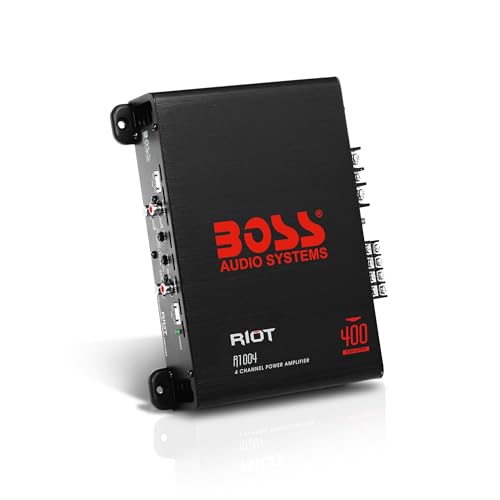
1. BOSS Audio Systems R1004 Riot Series 4 Channel Amplifier Car Audio – Class A/B
Rating: 8.7/10
Unleash the full potential of your car’s audio system with the BOSS Audio Systems R1004 Riot Series 4 Channel Amplifier. This powerful amp delivers a significant boost to your sound, making your music come alive. It’s designed to be versatile, fitting into many car setups. You can expect clear and strong audio for all your favorite tunes.
What We Like:
- It pumps out a strong 400 watts of maximum output power, giving your speakers a serious upgrade.
- The Class A/B design offers a great balance of sound quality and efficiency.
- It works with speaker impedances from 2 to 8 Ohms, meaning it’s flexible for different speaker setups.
- Both low-level (RCA) and high-level (+/- wire) inputs are supported, so it connects easily to most car stereos.
- The variable input gain control lets you fine-tune the signal, ensuring optimal performance without affecting volume.
- It boasts a very low Total Harmonic Distortion (THD) of 0.01%, meaning your audio will be clean and clear.
- The high Signal-to-Noise (S/N) ratio of 90 dB ensures you hear your music, not static or hiss.
- BOSS Audio Systems backs this amplifier with a generous 6-year Platinum Online Dealer Warranty when purchased through Amazon.com.
What Could Be Improved:
- While it offers high output, it’s important to note that professional installation is strongly recommended for safety and proper function.
This amplifier is a solid choice for anyone looking to enhance their car’s sound. Its combination of power, flexibility, and sound quality makes it a worthwhile upgrade.
2. Alpine S-A32F S-Series Class D 4-Channel Amplifier

Rating: 8.5/10
Upgrade your car’s sound system with the Alpine S-A32F S-Series Class D 4-Channel Amplifier. This amp delivers clean power to your speakers, making your music sound amazing. It’s a great way to get more out of your existing stereo or build a whole new sound system.
What We Like:
- It packs a punch with 55 watts RMS per channel at 4 ohms.
- You can easily power up your speakers with 80 watts RMS at 2 ohms.
- The amplifier can be bridged to provide 160 watts RMS to two speakers.
- It’s CTA-2006 compliant, meaning it meets industry standards for power output.
- You get flexibility with variable high- and low-pass filters to fine-tune your sound.
- The Class D design makes it efficient and compact.
What Could Be Improved:
- The filter range, while useful, might be limiting for some advanced tuning needs.
- More detailed setup guides could be helpful for beginners.
This Alpine amplifier is a solid choice for anyone looking to enhance their car audio. It offers good power and flexibility for a noticeable improvement in sound quality.
3. Car Audio Amplifier ZE1000.1 2000W Monoblock Class D MOSFET Subwoofer Audio

Rating: 8.5/10
The ZE1000.1 is a powerful monoblock amplifier built to bring serious bass to your car audio system. It’s designed to handle demanding subwoofers with its impressive 2000-watt peak power and 1000-watt RMS power at 1 ohm. This amp uses advanced Class D technology, which means it’s super efficient, doesn’t waste much energy as heat, and is surprisingly small and light. You can connect it to subwoofers with impedances from 1 to 4 ohms, and it’s packed with safety features to protect both your gear and your car.
What We Like:
- Massive power output for deep, impactful bass.
- Highly efficient Class D design saves energy and reduces heat.
- Compact and lightweight, making installation easier.
- 1-ohm stable operation lets you push your subwoofers to their limits.
- Built-in protection (thermal, overload, short circuit) keeps everything safe.
- Low pass crossover helps you fine-tune your subwoofer’s sound.
What Could Be Improved:
- RMS power at higher impedances (2 and 4 ohms) is lower than the peak power, which might be a consideration for some setups.
- “Stereo” is listed in the product title, but it’s a monoblock amplifier, meaning it’s designed for a single channel, typically for subwoofers.
This ZE1000.1 amplifier delivers big sound in a small package. It’s a solid choice for anyone wanting to upgrade their car’s bass performance.
4. Pyle 2 Channel Car Stereo Amplifier- 1400W Dual Channel Bridgeable High Power MOSFET Audio Sound Auto Small Speaker Amp w/ Crossover

Rating: 9.5/10
Upgrade your car’s sound system with the Pyle 2 Channel Car Stereo Amplifier, model PLA2200. This compact amp packs a punch with 1400 watts of power, making your music sound amazing. It’s designed to be bridgeable, meaning you can combine channels for even more power. This amplifier is a great way to boost your car’s audio experience.
What We Like:
- Massive 1400-watt power output delivers loud and clear sound.
- Bridgeable design lets you combine channels for extra power.
- Gold-plated RCA ports prevent signal loss for better audio quality.
- MOSFET power supply provides clean sound without distortion.
- Built-in thermal, overload, and short circuit protection keeps everything safe.
- Slim design makes it easy to install in tight spaces.
- Switchable bass boost lets you add more thump to your bass.
- Variable gain control allows you to fine-tune the sound.
- Configurable electronic crossover network helps optimize speaker performance.
What Could Be Improved:
- While powerful, it might be overkill for very small speaker setups.
- Users might need to consult the manual for advanced settings like the crossover.
This Pyle amplifier is a solid choice for anyone wanting better sound in their car. It offers great power and protection in a small package.
5. Pioneer GM-A3702 2-Channel Car Amplifier – 500W Max

Rating: 8.8/10
Want to make your car’s music sound amazing? The Pioneer GM-A3702 2-Channel Car Amplifier is here to help. This amp boosts your sound system, making music louder and clearer than your car’s basic radio. It’s designed to give your audio a serious upgrade.
What We Like:
- It delivers a powerful 500 watts of maximum power, making your music really hit hard.
- The Class AB design is efficient, giving you great sound without using too much power or getting too hot.
- It produces clean audio with very little distortion, so you hear your music just as it was meant to be heard.
- You can easily adjust the bass with the selectable low-pass filter, giving you more control over your sound.
- Its bridgeable design means you can use it to power one subwoofer for even more bass.
- It automatically turns on when it senses a signal, making installation simpler.
What Could Be Improved:
- The RMS power output (60 watts x 2) might be a bit low for very high-end speaker systems.
- While it has a low-pass filter, a high-pass filter would offer more complete audio customization.
This Pioneer amplifier is a solid choice for anyone wanting to improve their car’s sound. It offers great power and clarity for a more enjoyable listening experience on the road.
Choosing the Right Car Stereo Amp: Your Sound Upgrade Guide
Ready to make your car’s music thump? A car stereo amplifier, or amp, is your ticket to louder, clearer, and more powerful sound. It takes the weak signal from your head unit (your car’s radio) and makes it big and strong for your speakers. This guide will help you pick the perfect amp.
Why You Need an Amp
Your car’s factory stereo is okay, but it usually doesn’t have enough power. An amp boosts that power. This means your music will sound better, especially at higher volumes. You won’t get that fuzzy or distorted sound. It also helps your speakers perform at their best.
Key Features to Look For
When you shop for an amp, keep these features in mind:
Number of Channels
- 1-Channel (Mono): Best for subwoofers. It pushes lots of power to one speaker.
- 2-Channel: Powers two speakers, like your front ones. You can also “bridge” it to power a single subwoofer with more power.
- 4-Channel: Powers four speakers. This is a popular choice for full-range sound.
- 5-Channel: Powers four speakers and a subwoofer. It’s an all-in-one solution.
Power Output (RMS Watts)**
* This is the most important number. It tells you how much continuous power the amp can deliver to each speaker.
* Look for RMS (Root Mean Square) watts. This is a steady power rating, not a peak one.
* Match the amp’s RMS rating to your speakers’ RMS rating. Aim for the amp’s RMS to be close to, or slightly higher than, your speakers’ RMS. Too little power can damage speakers.
Signal-to-Noise Ratio (SNR)**
* This measures how much unwanted noise the amp adds to your music.
* A higher SNR (like 90dB or more) means cleaner sound.
Frequency Response**
* This shows the range of sound frequencies the amp can reproduce.
* A wider range (like 20Hz to 20kHz) means you’ll hear more of the music’s details.
Built-in Crossovers**
* Crossovers help direct the right sound frequencies to the right speakers.
* High-pass filters send higher sounds to smaller speakers.
* Low-pass filters send lower sounds to subwoofers.
* Many amps have these built-in, which saves you from buying separate ones.
Important Materials and Build Quality
The way an amp is built matters for sound and durability.
* **Heat Sinks:** Good amps have large aluminum heat sinks. These keep the amp cool, which helps it perform better and last longer. Overheating can cause damage.
* **Circuit Boards:** High-quality circuit boards reduce noise and improve sound.
* **Connections:** Sturdy, gold-plated connections ensure a good electrical connection and resist corrosion.
Factors That Improve or Reduce Quality
* **Improve Quality:**
* **Reputable Brands:** Stick with well-known car audio brands. They often use better components.
* **Clean Power:** Amps that provide clean, stable power sound better and are safer for your speakers.
* **Good Wiring:** Using the correct gauge (thickness) of power and speaker wire is crucial. Thin wires can limit power and cause heat.
* **Reduce Quality:**
* **”Peaked” Power Ratings:** Be wary of amps that only list huge “peak” or “max” power numbers. RMS is the real measure.
* **Poor Heat Dissipation:** Amps that get too hot quickly can distort sound and fail.
* **Cheap Components:** Low-quality internal parts can lead to noise and a shorter lifespan.
User Experience and Use Cases
* **Everyday Listening:** If you just want your music to sound clearer and a bit louder on your commute, a 4-channel amp powering your front and rear speakers is a great choice.
* **Bass Enthusiasts:** If you love deep bass, you’ll want a mono amp dedicated to powering a subwoofer.
* **Full System Upgrade:** For the ultimate sound experience, you might use a multi-channel amp (like a 5-channel) or separate amps for your speakers and subwoofer.
* **Ease of Installation:** Some amps are designed for simpler installation, which can be good if you’re doing it yourself.
—
Frequently Asked Questions (FAQs)
Q: What is RMS power?
A: RMS power tells you how much steady power an amplifier can give to your speakers. It’s the most important number to look at for an amp.
Q: Do I need an amp if I have new speakers?
A: New speakers can sound better with an amp. An amp gives them the power they need to perform their best.
Q: How many channels do I need?
A: It depends on how many speakers you want to power. A 4-channel amp is common for all your main speakers.
Q: Can I use an amp with my factory radio?
A: Yes, you can. You might need an adapter to connect it, but it’s definitely possible.
Q: What is bridging an amp?
A: Bridging means you combine two channels of an amp to power one speaker, usually a subwoofer, with more power.
Q: How do I know if an amp is too powerful for my speakers?
A: Check the RMS power rating of your speakers. The amp’s RMS output per channel should be close to or a little higher than the speaker’s RMS rating.
Q: Will an amp make my music sound distorted?
A: Not if you choose the right amp and set it up correctly. An amp actually helps prevent distortion by giving your speakers enough clean power.
Q: What’s the difference between a mono and a 2-channel amp?
A: A mono amp is made for one speaker, like a subwoofer. A 2-channel amp is for two speakers, like your front door speakers.
Q: Do I need a special wiring kit for my amp?
A: Yes, you need a wiring kit. It includes the power wire, ground wire, and other cables needed to connect the amp safely.
Q: Is it hard to install a car stereo amp?
A: It can be a bit tricky. It involves running wires, making connections, and setting things up. Many people hire a professional if they’re not comfortable doing it themselves.
In conclusion, every product has unique features and benefits. We hope this review helps you decide if it meets your needs. An informed choice ensures the best experience.
If you have any questions or feedback, please share them in the comments. Your input helps everyone. Thank you for reading.