
Yes, you can often extend a car lease, but it’s not always the simplest or most cost-effective solution. The ability to extend a lease and the specific terms depend heavily on your original lease contract and the dealership or leasing company you’re working with. This guide will walk you through your car lease options at the end of your term, including extending your lease, buying out your lease, or exploring alternatives.
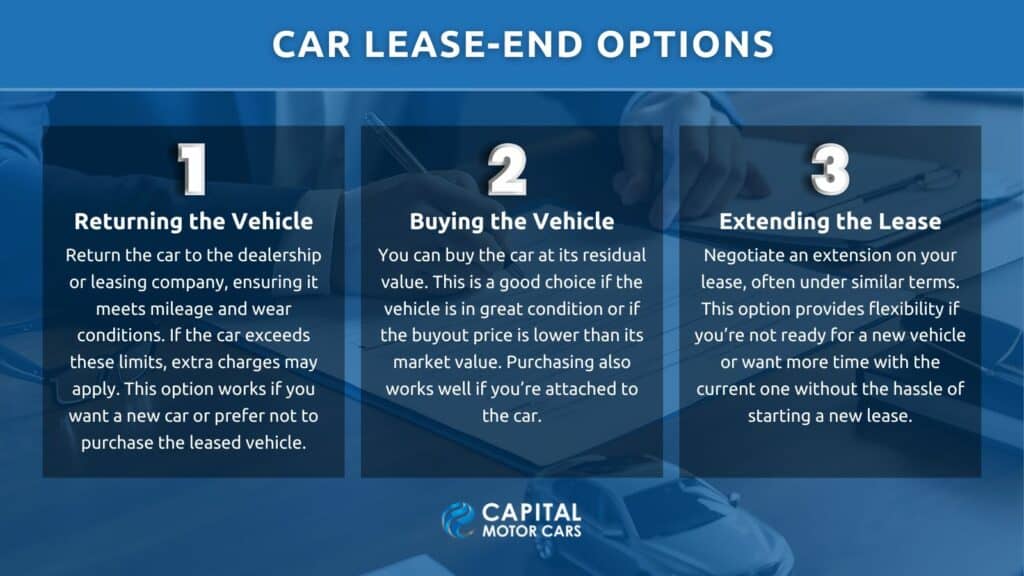
Image Source: capitalmotorcars.com
Deciphering Your Lease End Options
When your car lease contract is nearing its end, you’ll face a few critical decisions. Understanding these choices thoroughly ensures you make the best financial move for your situation. The most common pathways include returning the car, extending the lease, or purchasing the vehicle.
The Possibility of a Lease Extension
A lease extension, sometimes called a lease renewal, offers a way to keep your current vehicle beyond the original lease contract period. This can be a good option if you’re happy with the car, haven’t accumulated excessive mileage, and the extension terms are favorable.
Why Extend Your Lease?
- Familiarity and Comfort: You know the car, its quirks, and its maintenance history.
- No New Car Hassles: Avoid the stress of shopping for a new vehicle, negotiating prices, and learning new features.
- Potential for Lower Payments: In some cases, an extension might offer a slightly lower monthly payment, though this isn’t guaranteed.
- Bridge to a New Purchase: If you’re saving for a new car but need more time, an extension can be a temporary solution.
How to Negotiate a Lease Extension
- Review Your Original Lease Contract: Look for any clauses related to lease extensions. Some contracts may explicitly state whether extensions are allowed and under what conditions.
- Contact Your Leasing Company Early: Don’t wait until the last minute. Reach out to the leasing company or dealership several months before your lease ends. This gives you time to explore options and negotiate.
- Inquire About Terms: Ask for a written quote detailing the monthly payment, the duration of the extension, any mileage restrictions, and the residual value if a buyout is considered later.
- Be Prepared to Negotiate: The initial offer might not be the best. Be ready to discuss the terms, especially if your car has held its value well or you’ve been a loyal customer.
- Consider Mileage Limits: Most lease extensions come with a mileage allowance. If you drive a lot, ensure the extended mileage allowance is sufficient, or you might face hefty overage charges. Your original lease mileage allowance might not apply directly.
What to Watch Out For with Lease Extensions
- Increased Monthly Payments: While not always the case, some extensions might have higher monthly payments than your original lease, especially if the residual value has decreased.
- No New Car Warranty: If your extension goes beyond your original warranty period, you’ll be responsible for all repair costs.
- Mileage Overage Charges: Exceeding the agreed-upon mileage limit during an extension can be very expensive.
- Lack of Equity Building: You’re essentially renting the car for longer without building any ownership.
The Lease Buyout Option
Another popular lease end option is a lease buyout. This is where you purchase the car at the end of your lease term for a predetermined price, known as the residual value.
Types of Lease Buyouts
- Dealer Buyout (or Lease End Purchase): This is the most common type. You purchase the car directly from the dealership where you leased it.
- Third-Party Buyout: You can often arrange financing through your own bank or credit union, potentially securing a better interest rate than through the dealership.
Pros of a Lease Buyout
- Ownership: You own the car outright, free from lease restrictions.
- No Mileage Limits: Once you own it, you can drive as much as you want without worrying about lease mileage allowance.
- Avoid Lease End Fees: You typically avoid excess wear-and-tear charges and disposition fees.
- Potential for Equity: If the car is worth more than its residual value, you have instant equity.
- Continue Driving a Familiar Car: Similar to an extension, you keep a car you know and like.
Cons of a Lease Buyout
- Upfront Costs: You’ll need to pay the residual value, plus taxes, fees, and potentially a down payment if you finance.
- No More Warranty: Similar to an extension, you might be out of warranty, making you responsible for repairs.
- Resale Value Uncertainty: The car’s actual market value might be less than the residual value, meaning you’d be paying more than it’s worth on the open market.
- Loan Payments: If you finance the buyout, you’ll have monthly loan payments.
Evaluating Your Car Lease Options
When deciding between extending, buying out, or returning, consider these factors:
- Your Financial Situation: Can you afford the upfront costs of a buyout or the potential higher payments of an extension?
- Your Driving Habits: How many miles do you typically drive annually? Will an extension’s lease mileage allowance be sufficient?
- The Car’s Condition: Has the car been well-maintained? Are there any significant damages that could lead to high wear-and-tear charges if returned?
- The Car’s Market Value: Research the current market value of your vehicle. Is it significantly higher or lower than the buyout price?
- New Car Market: Are there attractive new car deals or used car lease specials available that might be more appealing?
Exploring the Nuances of Lease Terms
Your lease contract is the governing document for your vehicle. Fathoming its lease terms is crucial when considering any post-lease actions.
Key Lease Contract Provisions
- Lease Term: The duration of the lease (e.g., 24, 36, 48 months).
- Mileage Allowance: The maximum number of miles you can drive per year without penalty.
- Residual Value: The estimated value of the car at the end of the lease term, which is the basis for your buyout price.
- Purchase Option Price: The specific dollar amount at which you can buy the car at lease end.
- Early Termination Clause: Conditions under which you can end the lease before the scheduled end date. This is important if your circumstances change drastically.
Early Lease Termination: A Costly Alternative
While not directly an extension, understanding early lease termination is vital in the context of lease end options. If your situation changes unexpectedly (e.g., job loss, relocation, need for a different vehicle), you might consider ending your lease early.
- Penalties: Early lease termination almost always involves significant penalties. You might have to pay the remaining lease payments, a depreciation charge, and a disposition fee.
- Equity Assessment: Sometimes, if the car’s market value is significantly higher than its remaining lease balance, you might be able to sell it or trade it in without a major loss. However, this is rare and requires careful calculation.
Renewing a Car Lease vs. Other Lease End Options
When it comes to renewing a car lease, it’s essentially a short-term extension. The terms might differ from a standard lease extension.
Differences Between Renewing and Extending
- Duration: Renewals are typically shorter, often month-to-month or for a few months, whereas extensions can be for a year or more.
- Payment Adjustments: Renewals might come with a different payment structure than a longer-term extension.
- Purpose: Renewals are often used as a stopgap measure while a customer decides on a longer-term solution.
When is Extending a Lease Not a Good Idea?
- High Mileage: If you’ve exceeded your lease mileage allowance or anticipate doing so during an extension, it’s usually not worth it.
- Excessive Wear and Tear: If the car has significant cosmetic or mechanical issues beyond normal wear and tear, you’ll likely face hefty charges upon return, and buying it out means you’re inheriting those repair costs.
- New Car Deals: If the market is flooded with attractive new car lease specials or sales, you might find a better deal on a newer model.
- Technological Obsolescence: Cars evolve quickly. If your current car lacks modern safety or infotainment features, an extension might keep you in an outdated vehicle.
Alternatives to Extending Your Lease
If extending your lease doesn’t make sense, or you’re looking for different car lease options, consider these alternatives:
Purchasing a New Vehicle
This is the most straightforward alternative. You can lease a new vehicle or purchase one outright with financing.
- Leasing a New Car: This allows you to drive a brand-new vehicle with the latest features and technology, typically with a new car warranty. You can choose new lease terms and mileage allowances that suit your needs.
- Buying a New Car: If you plan to keep the car for many years and drive a lot, buying outright or financing a purchase might be more economical in the long run than leasing.
Exploring Used Car Leases
A used car lease can be an interesting option, offering lower monthly payments than a new car lease.
- Benefits: Lower initial costs, lower monthly payments, and depreciation is already accounted for.
- Considerations: Mileage limitations might be stricter, and warranty coverage could be limited or non-existent. The selection of used cars available for lease can also be more limited.
Purchasing a Certified Pre-Owned (CPO) Vehicle
CPO vehicles are typically used cars that have undergone rigorous inspections and come with extended warranties from the manufacturer.
- Advantages: They offer peace of mind similar to new cars but at a lower price point. You can often finance CPO vehicles, building equity.
- No Lease Restrictions: Once purchased, you own the car and are free from mileage limits.
Making the Final Decision: A Comparative Look
To help you decide, let’s compare the primary lease end options:
| Feature | Lease Extension | Lease Buyout | Returning the Vehicle |
|---|---|---|---|
| Goal | Keep current car for longer | Own current car | End lease obligations, get new car |
| Monthly Payment | Potentially similar or slightly higher | Loan payment if financed, or lump sum | No further payments (unless fees apply) |
| Ownership | No ownership | Full ownership | No ownership |
| Mileage Limits | Yes, usually with an extension allowance | No | N/A (beyond lease contract) |
| Wear & Tear Fees | Avoided if staying, but may affect future buyout | Avoided | Potential fees apply |
| Upfront Costs | Minimal, possibly an extension fee | Residual value + taxes/fees (or down payment for financing) | None (unless paying end-of-lease fees) |
| Warranty | May expire during extension | Likely expired or expiring | N/A |
| Long-Term Cost | Can be higher due to continued depreciation | Can be lower if residual is favorable | Depends on next vehicle choice |
| Flexibility | Low (tied to original car) | High (own it) | High (freedom to choose next vehicle) |
Financial Projections: An Example
Let’s consider a hypothetical scenario:
- Original Lease: 36 months, $400/month, 12,000 miles/year.
- Residual Value: $20,000
- Current Market Value: $22,000
- Lease Extension Offer: 12 months, $420/month, 10,000 miles/year.
- Financing a Buyout: 48 months at 5% interest on $20,000.
Scenario 1: Lease Extension
* Total Cost for Extension: $420/month * 12 months = $5,040.
* Mileage: You’ll be limited to 10,000 miles.
Scenario 2: Lease Buyout
* Buyout Price: $20,000 + taxes and fees (let’s estimate $1,500 for this example) = $21,500.
* Financed Monthly Payment: Approximately $475/month for 48 months.
* Total Cost of Buyout (over 48 months): $475/month * 48 months = $22,800.
* Equity: You own a car worth $22,000 for a total cost of $21,500 (buyout price), meaning you have $500 in immediate equity. You also have no mileage restrictions.
In this example, while the lease extension has a lower monthly cost, buying out the vehicle provides ownership and, in this specific case, a small immediate equity gain, with no mileage restrictions going forward. However, if the market value was less than the residual value, the buyout would be less attractive.
Frequently Asked Questions (FAQ)
Q1: Can I extend my car lease if I exceeded the lease mileage allowance?
A: It’s unlikely. Most lease contracts have strict clauses about mileage. If you’ve exceeded your lease mileage allowance, the leasing company will likely charge you for the overage when you try to extend or buy out. They may refuse an extension altogether.
Q2: What happens if I don’t do anything when my lease ends?
A: If you don’t return the car, extend the lease, or buy it out by the end date, you’ll likely be charged a significant penalty for failure to return the vehicle. This is often a daily rate, and it can add up quickly. You’ll also be liable for the vehicle’s value.
Q3: Can I negotiate the buyout price of my lease?
A: Generally, the residual value stated in your lease contract is the predetermined buyout price. However, in some cases, you might be able to negotiate, especially if the car’s market value has dropped significantly below the residual value. It’s worth a try, but the dealership or leasing company isn’t obligated to negotiate.
Q4: What is a “used car lease”?
A: A used car lease is a lease agreement for a vehicle that is not brand new. These leases are less common than new car leases but can offer lower monthly payments. The terms, mileage limits, and warranty coverage can vary significantly.
Q5: How can I find out the residual value of my leased car?
A: The residual value is clearly stated in your original lease contract. You can also contact your leasing company or the dealership to inquire about your car’s current buyout price, which is usually based on the residual value plus any applicable taxes and fees.
Q6: Are there any fees associated with extending a car lease?
A: Some leasing companies may charge a small administrative fee for processing a lease extension. It’s important to ask about any potential fees upfront.
Q7: What’s the difference between renewing a car lease and a lease extension?
A: Renewing a car lease typically refers to a shorter-term extension, often on a month-to-month basis. A lease extension is usually a more formal agreement for a longer period, perhaps six months to a year or more. The terms and payment adjustments can differ between the two.
By carefully weighing your options and understanding the intricacies of your lease contract, you can confidently navigate the end of your lease and make the choice that best suits your automotive needs and financial goals. Whether you extend, buyout, or move on to a new vehicle, informed decision-making is key.