
Does your car suddenly sound like it’s struggling through a field of tall grass? A lawnmower-like noise from your vehicle can be unsettling, and it’s often a sign that something needs attention. This sound is typically caused by issues within the engine, exhaust system, or other mechanical components.
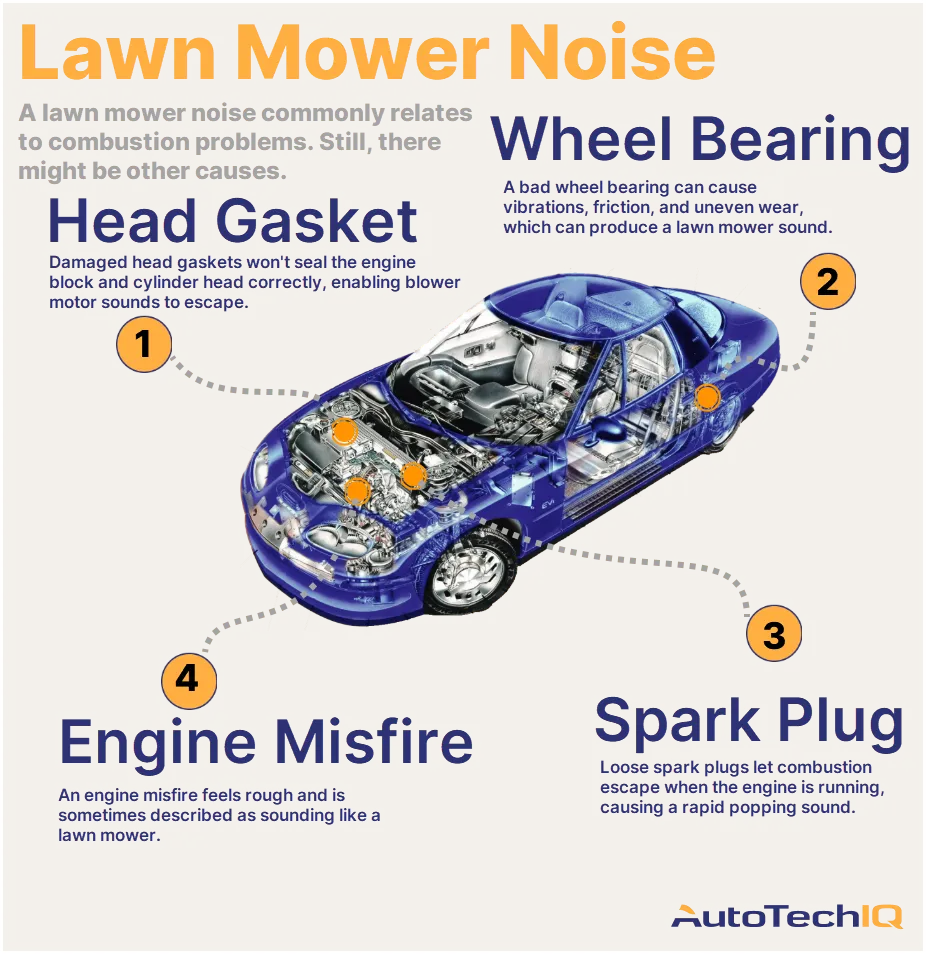
Image Source: www.autotechiq.com
Deciphering the Grinding Growl: What’s Making That Noise?
A car sounding like a lawnmower isn’t a single issue, but rather a symptom of various mechanical problems. The most common culprits include problems with the exhaust system, engine misfires, or issues with the belts and pulleys. We’ll delve into these and more.
The Exhaust System: A Symphony of Leaks and Damage
The exhaust system’s primary job is to quiet the loud noises your engine makes and to safely expel exhaust gases. When parts of it are damaged or leaking, those noises can escape and create a variety of unpleasant sounds, often resembling a sputtering or grinding engine.
Exhaust Leak: Where the Sound Escapes
An exhaust leak is one of the most frequent reasons your car might sound like a lawnmower. These leaks can happen anywhere along the exhaust path, from the engine’s exhaust manifold all the way to the tailpipe.
Manifold Leak: The Starting Point of Trouble
Your engine has exhaust manifolds, which are metal pipes that collect exhaust gases from each cylinder. If a crack forms in the exhaust manifold or if the gasket between the manifold and the engine head fails, exhaust gases can escape under pressure. This escaping gas can create a loud, puffing or ticking sound, especially when the engine is cold or under acceleration, which can be mistaken for a lawnmower sound. A manifold leak is a critical issue because it not only affects performance but can also allow harmful exhaust fumes into the cabin.
Leaks Further Down: Pipes and Connections
As exhaust gases travel through the exhaust pipes, they pass through various components like the catalytic converter and muffler. Leaks can develop at connection points (flanges) due to rust or loose clamps, or through holes that form in the pipes themselves, often caused by corrosion or physical damage. These leaks create a hissing or puffing noise that can become more pronounced as engine RPMs increase, sounding like a sputtering engine.
Muffler Damage: The Silent Sentinel Compromised
The muffler is designed to reduce the noise produced by the engine’s combustion process. It contains baffles and chambers that break up sound waves.
Internal Muffler Failure: Rumbles and Rattles
If the internal baffles of your muffler become loose or break off, they can rattle around inside the muffler. This rattling, combined with the normal exhaust flow, can create a deep rumbling or buzzing sound that might mimic a lawnmower.
External Muffler Damage: Punctures and Holes
Impacts from road debris or severe rust can cause holes or cracks in the muffler’s outer casing. These openings allow exhaust gases to escape without being properly muffled, leading to a significantly louder and rougher engine sound.
Catalytic Converter Issues: More Than Just a Smell
The catalytic converter is a crucial part of the exhaust system that converts harmful pollutants into less harmful gases. However, it can also contribute to lawnmower-like sounds.
Clogged Catalytic Converter: Restricted Flow
When a catalytic converter becomes clogged with carbon deposits or debris, it restricts the flow of exhaust gases. This restriction can cause the engine to struggle, leading to a loss of power and a sputtering or backfiring sound that can be similar to a struggling lawnmower.
Damaged Internal Components: Rattling and Grinding
The internal ceramic honeycomb structure of a catalytic converter can break apart over time, especially if exposed to extreme temperatures or impacts. These loose pieces can rattle around inside the converter, creating a metallic rattling or grinding noise that becomes more noticeable under acceleration. This can also be a sign of a failing catalytic converter.
Engine Knocks and Misfires: Internal Combustion Chaos
The core of your car’s operation is the engine. When internal combustion goes awry, it can produce a symphony of unusual sounds.
Engine Knocking: The Unwanted Pinging
Engine knocking, also known as detonation or pinging, is a sharp, metallic sound that occurs when fuel ignites prematurely in the combustion chamber. This can be caused by several factors:
- Low Octane Fuel: Using gasoline with an octane rating lower than recommended by your car manufacturer can lead to knocking.
- Carbon Buildup: Deposits in the combustion chamber can create hot spots, causing the fuel-air mixture to ignite too early.
- Incorrect Ignition Timing: If the spark plugs fire at the wrong moment, it can cause the fuel to ignite unevenly.
- Overheating Engine: An engine running too hot is more prone to premature ignition.
The sound of engine knocking is often described as a series of rapid taps or pings, but in some cases, it can be a more persistent, grinding noise that might be confused with a lawnmower.
Engine Misfire: The Missing Pulse
An engine misfire occurs when one or more cylinders fail to combust the fuel-air mixture properly. This can result in a rough idle, hesitation during acceleration, and a distinctive sputtering sound.
Faulty Spark Plugs: The Ignition Weak Link
Spark plugs ignite the fuel-air mixture in each cylinder. If a spark plug is worn, fouled with carbon, or has an incorrect gap, it may not produce a strong enough spark, or any spark at all. This can lead to an engine misfire. The sound from a misfiring cylinder can be a rhythmic “chugging” or sputtering that, when combined with other exhaust noises, might sound like a lawnmower.
Ignition Coil or Wire Problems: Delivery Disruptions
The ignition coil provides the high voltage needed to fire the spark plugs, and ignition wires deliver that voltage. If a coil is failing or a wire is damaged, the spark will be weak or absent, causing a misfire. This can create a similar sputtering noise.
Fuel Injector Issues: Fueling Failures
A clogged or malfunctioning fuel injector can deliver too little or no fuel to a cylinder, resulting in a misfire. The engine will then run rougher, and the uneven firing can produce noises reminiscent of a sputtering lawnmower.
Belt Squeal and Pulley Problems: The Unseen Spinners
Under the hood, various belts drive essential components like the alternator, power steering pump, and air conditioning compressor. Problems with these can also create odd noises.
Belt Squeal: The Annoying Whine
A common cause of high-pitched squealing or chirping sounds, especially on startup or when turning the steering wheel, is a worn or loose serpentine belt (or V-belt on older cars). The belt can slip on the pulleys, creating this noise. While often a squeal, a worn belt that’s constantly slipping and catching can sometimes produce a more irregular, choppy sound that might be perceived as a lawnmower-like noise, particularly if it’s happening intermittently or under load.
Pulley Problems: Bearing Woes
The pulleys that the belts run on have bearings. If these bearings wear out, they can become noisy, producing a grinding or squealing sound. A failing bearing in an alternator, power steering pump, or idler pulley can create a noise that might contribute to the overall “lawnmower” impression your car is making.
Transmission Problems: When Shifting Goes Wrong
While less common for a direct “lawnmower” sound, transmission issues can sometimes manifest in ways that could be misinterpreted.
Transmission Slippage: Gears That Don’t Engage
If your transmission is starting to slip, it means the gears aren’t engaging properly. This can cause the engine to rev up without a corresponding increase in speed, and the engine might sound like it’s working harder and making a rougher noise. This can be particularly noticeable during acceleration and might add to a perceived lawnmower-like sound.
Low Transmission Fluid: Lubrication Lacking
Low transmission fluid levels can cause the transmission to work harder and potentially overheat, leading to unusual noises. While not a direct lawnmower sound, the strain on the engine and transmission could contribute to a rougher overall noise profile.
Loose Heat Shield: The Vibrating Annoyance
Heat shields are thin metal pieces installed around exhaust components to protect the underbody of your car from heat. They are often attached with small bolts or clips.
Rattling and Vibrating: A Common Culprit
Over time, these shields can become loose due to rust or vibration. When loose, they can vibrate against the exhaust pipes or other components, creating a metallic rattling or buzzing sound that can be quite loud and persistent, especially at certain engine speeds. This kind of noise, particularly if it’s a lower-frequency rattle, can easily be mistaken for a lawnmower sound.
Diagnostic Steps: Pinpointing the Source of the Sound
When you hear a lawnmower-like sound from your car, the first step is to try and isolate when the sound occurs and from where it seems to originate.
Gathering Clues: Observation is Key
- When does the sound occur?
- When the engine is cold or hot?
- At idle or only when accelerating?
- When turning or going over bumps?
- Does it change with engine RPM?
- Where does the sound seem to come from?
- Under the hood?
- From underneath the car?
- From the front or rear?
Basic Checks You Can Do
- Visual Inspection: Look for obvious signs of damage, such as hanging exhaust parts, loose shields, or oil leaks.
- Listen Carefully: With the engine running (in a safe, well-ventilated area), try to pinpoint the source of the noise. You might be able to hear if it’s coming from a specific area.
When to Seek Professional Help
Many of these issues require specialized tools and knowledge. If you’re not comfortable working on cars, it’s best to take your vehicle to a trusted mechanic. They can perform a more thorough diagnosis.
Table of Common Causes and Symptoms
| Problem Area | Potential Cause | Typical Sound Description | Other Symptoms |
|---|---|---|---|
| Exhaust System | Exhaust Leak (Manifold) | Loud puffing, ticking, or hissing from the engine bay | Decreased power, exhaust smell in cabin, check engine light |
| Exhaust System | Exhaust Leak (Pipe/Connection) | Hissing, puffing, or roaring sound from underneath the car | Louder exhaust noise, possible drone, check engine light |
| Exhaust System | Muffler Damage (Internal) | Deep rumbling, buzzing, or rattling | Louder exhaust, possibly rattling under the car |
| Exhaust System | Muffler Damage (External) | Loud, un-muffled exhaust noise | Visible hole in muffler, very loud exhaust |
| Exhaust System | Catalytic Converter (Clogged) | Sputtering, backfiring, loss of power | Poor acceleration, sluggish performance |
| Engine | Engine Knocking | Sharp metallic pinging, tapping, or grinding | Reduced power, overheating, check engine light |
| Engine | Engine Misfire (Spark Plug) | Rough idle, sputtering, uneven engine operation | Stumbling on acceleration, check engine light, poor MPG |
| Engine | Engine Misfire (Coil/Wire) | Similar to spark plug misfire | Hesitation, rough running, check engine light |
| Engine | Engine Misfire (Injector) | Rough idle, sputtering | Poor fuel economy, check engine light |
| Belts & Pulleys | Worn/Loose Serpentine Belt | High-pitched squeal, chirping, or rougher chattering | Loss of power to accessories (AC, power steering), battery light |
| Belts & Pulleys | Failing Pulley Bearing | Grinding, squealing, or whining | Accessory failure, loud noise from a specific pulley |
| Transmission | Transmission Slippage | Engine revving without acceleration, rough shifting | Jerky gear changes, difficulty accelerating |
| Heat Shields | Loose Heat Shield | Metallic rattling or buzzing, especially at certain RPMs | Noise is often localized to the exhaust area |
Frequently Asked Questions (FAQ)
Q1: Can I continue driving if my car sounds like a lawnmower?
It depends on the severity and the underlying cause. If the sound is minor and doesn’t affect performance, you might be able to drive it for a short time to get it diagnosed. However, if the sound is loud, accompanied by a loss of power, warning lights, or rough running, it’s best to stop driving and have it towed to a mechanic. Ignoring certain noises, like significant exhaust leaks or engine knocking, can lead to more severe and costly damage.
Q2: Is a lawnmower sound a sign of a serious problem?
It can be. While a loose heat shield might just be annoying, an exhaust leak near the engine or severe engine knocking can indicate more critical issues that need immediate attention. Engine misfires can also lead to catalytic converter damage if left unaddressed. It’s always best to err on the side of caution.
Q3: How much does it cost to fix a car that sounds like a lawnmower?
The cost varies greatly depending on the cause. A loose heat shield might be a simple bolt tightening costing very little. A significant exhaust leak repair could cost several hundred dollars. Replacing a catalytic converter or addressing internal engine issues like knocking can run into thousands of dollars. Your mechanic will provide an estimate after diagnosing the problem.
Q4: Can a bad muffler make my car sound like a lawnmower?
Yes, a damaged muffler is a very common cause of loud exhaust noises that can be described as sounding like a lawnmower, especially if the internal baffling has failed or the muffler casing has a hole.
Q5: What’s the difference between engine knocking and an engine misfire?
Engine knocking is a premature ignition of the fuel-air mixture within the cylinder, causing a sharp pinging or rattling sound. An engine misfire is when a cylinder fails to ignite the fuel-air mixture, leading to a rougher, sputtering, or uneven engine sound, often accompanied by a loss of power. Both can contribute to a lawnmower-like sound profile, but they have different root causes.