
So, how many BTU do you need to heat a 2-car garage? The answer is generally between 5,000 to 10,000 BTU, but this can vary significantly based on several factors.
Heating a 2-car garage requires careful consideration of its size, insulation, climate, and desired temperature. Simply guessing can lead to an under-heated or over-heated space, wasting energy and money. This in-depth guide will help you determine the right Garage heating BTU calculator inputs and the recommended BTU for garage heating to ensure comfort and efficiency. We’ll explore everything from garage climate control BTUs to choosing the right heater for your specific needs.
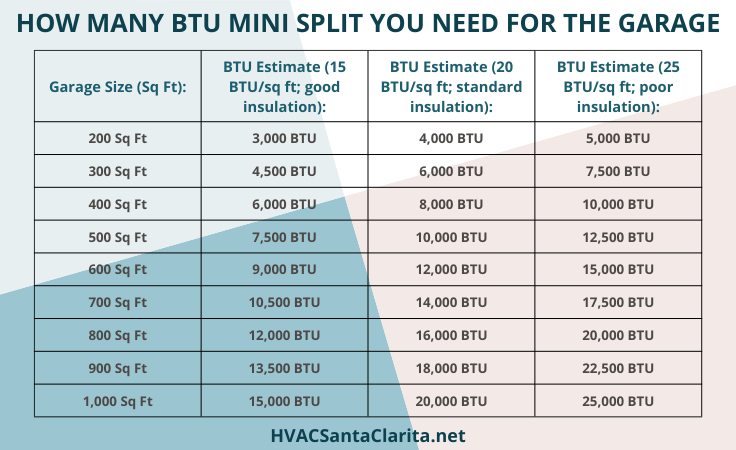
Image Source: hvacsantaclarita.net
Fathoming Your Garage Heating Requirements
Before diving into BTU calculations, it’s crucial to grasp the factors influencing your garage heating requirements. These elements will dictate the size and type of heater you’ll ultimately need.
Garage Size: The Foundation of Your Calculation
The most basic factor is the dimensions of your garage. A standard 2-car garage is typically around 20 feet wide by 20 feet deep, giving you a floor area of 400 square feet. However, many garages are larger or have higher ceilings.
- Length, Width, and Height: Measure your garage accurately. The height is particularly important as a larger volume of air requires more energy to heat.
- Square Footage: Calculate the total square footage by multiplying length by width.
- Cubic Footage: For a more precise calculation, multiply square footage by ceiling height to get the cubic footage.
Insulation: A Major Determinant of Heat Loss
The presence and quality of insulation in your garage walls, ceiling, and door are perhaps the most significant factors in determining your garage insulation BTUs needs.
- Uninsulated Garage: An uninsulated garage acts like a metal box, allowing heat to escape rapidly. This will require a higher BTU output.
- Basic Insulation: Some insulation in the walls and ceiling will significantly reduce heat loss.
- Well-Insulated Garage: A garage with high R-value insulation in all areas, including a well-sealed insulated door, will retain heat much more effectively, allowing for a lower BTU requirement.
How Insulation Affects BTU Needs:
Think of insulation as a blanket for your garage. The better the blanket, the less heat you need to add to keep it warm. A poorly insulated garage will lose heat quickly, forcing your heater to work harder and longer.
Climate and Outdoor Temperature: The External Challenge
Your local climate plays a critical role. If you live in a region with frigid winters, your garage heater will need to overcome much lower outdoor temperatures compared to someone in a milder climate.
- Average Winter Lows: Research the average lowest temperatures in your area during winter. This will give you an idea of the temperature difference your heater needs to manage.
- Temperature Difference (Delta T): This is the difference between your desired indoor temperature and the average outdoor temperature. A larger Delta T means you’ll need more BTUs.
Desired Indoor Temperature: Setting Your Comfort Level
What do you want your garage to feel like? Are you aiming for a toasty 70°F, or is a modest 50°F sufficient for working on projects?
- Comfort vs. Storage: If the garage is primarily for car storage and occasional access, a lower temperature might be acceptable. If you plan to spend significant time working in the garage, a warmer temperature will be necessary.
- Temperature Ramps: Consider how quickly you need the garage to reach your desired temperature. A powerful heater can warm the space faster.
Air Leaks and Drafts: The Silent Heat Thieves
Even with good insulation, air leaks and drafts can undermine your heating efforts.
- Doors and Windows: Check the seals on your garage door, any side doors, and windows.
- Electrical Outlets and Light Fixtures: These can be surprising sources of air infiltration.
- Cracks and Gaps: Inspect for any visible cracks in the foundation or walls.
Sealing these leaks is a crucial first step before even considering a heater. It’s often more efficient to prevent heat loss than to generate more heat.
Deciphering the BTU Formula for Your Garage
The British Thermal Unit (BTU) is the standard measure of heat energy. To determine how many BTUs you need, we can use a simplified formula. A common starting point for heating a 2-car garage BTU calculation involves multiplying the square footage by a factor that accounts for insulation and climate.
The Basic BTU Calculation
A widely used rule of thumb for calculating the necessary BTUs for a space is:
BTU Required = Square Footage × Temperature Difference × Heat Loss Factor
Let’s break down each component:
- Square Footage: As discussed, this is the area of your garage floor.
- Temperature Difference (Delta T): This is your desired indoor temperature minus the lowest expected outdoor temperature. For example, if you want 50°F and the lowest outdoor temp is -10°F, your Delta T is 60°F.
- Heat Loss Factor: This factor accounts for insulation, window quality, and air leakage. It’s the most subjective part of the calculation.
Garage Insulation BTUs Adjustment
The garage insulation BTUs factor is critical. Here’s a general guide:
- Uninsulated: Multiply by 30-40 BTU per square foot.
- Poorly Insulated (some insulation, gaps): Multiply by 20-30 BTU per square foot.
- Moderately Insulated (decent insulation, good door seals): Multiply by 10-20 BTU per square foot.
- Well-Insulated (high R-value, vapor barrier, sealed doors/windows): Multiply by 5-10 BTU per square foot.
Simplified Garage Heater Sizing Example
Let’s assume a standard 2-car garage:
- Size: 20 ft x 20 ft = 400 sq ft.
- Desired Temperature: 50°F.
- Lowest Outdoor Temperature: -10°F.
- Temperature Difference (Delta T): 50°F – (-10°F) = 60°F.
- Insulation Level: Moderately insulated.
Using the simplified BTU calculation:
BTU Required = Square Footage × Temperature Difference Factor
For a moderately insulated garage and a typical desired temperature increase, a common factor is around 10-15 BTU per square foot for every 40°F difference in temperature. However, to be more precise, let’s use the more detailed formula structure, focusing on how insulation modifies the basic per-square-foot requirement.
A more practical approach often used in garage heater sizing is to consider BTUs per square foot based on insulation and climate.
- Uninsulated garage in a cold climate: 50-60 BTU per square foot.
- Insulated garage in a cold climate: 20-30 BTU per square foot.
- Uninsulated garage in a mild climate: 30-40 BTU per square foot.
- Insulated garage in a mild climate: 10-20 BTU per square foot.
Let’s re-evaluate with these factors:
Scenario 1: Moderately Insulated Garage (400 sq ft) in a Cold Climate (lowest temp -10°F, want 50°F)
- BTU per square foot (moderate insulation, cold climate): 25 BTU/sq ft
- Total BTU = 400 sq ft × 25 BTU/sq ft = 10,000 BTU
This aligns with our initial estimate.
Scenario 2: Well-Insulated Garage (400 sq ft) in a Mild Climate (lowest temp 20°F, want 60°F)
- BTU per square foot (well-insulated, mild climate): 15 BTU/sq ft
- Total BTU = 400 sq ft × 15 BTU/sq ft = 6,000 BTU
This shows how insulation and climate dramatically change the requirement.
Using a Garage Heating BTU Calculator
For the most accurate results, consider using an online Garage heating BTU calculator. These tools often ask for more detailed information, such as:
- Garage dimensions (length, width, height)
- Insulation levels (walls, ceiling, door)
- Window and door types and seals
- Your location (for average temperature data)
- Desired indoor temperature
These calculators automate the complex calculations and provide a more tailored recommendation for your garage climate control BTUs.
Choosing the Right Garage Heater Type
Once you have an idea of your BTU needs, you can select the appropriate heater. The type of heater you choose will also influence the BTU output required and how efficiently it heats the space.
Portable Garage Heater BTU Considerations
Portable garage heater BTU options are popular for their flexibility. They are easy to move and can be used in different areas as needed.
- Electric Space Heaters: These are generally suitable for smaller, well-insulated garages or for supplemental heat.
- Pros: Easy to use, no ventilation needed, relatively inexpensive to buy.
- Cons: Can be expensive to run due to electricity costs, may not provide enough heat for larger or poorly insulated spaces. A typical 1500-watt electric heater produces about 5,100 BTU. For a 2-car garage, you might need two or more of these, or a higher wattage model if available.
- Propane/Kerosene Heaters: These are powerful and can heat large spaces quickly.
- Pros: High heat output, portable.
- Cons: Require proper ventilation due to carbon monoxide production, fuel costs, need fuel storage. A propane garage heater BTU output can range from 10,000 to 60,000 BTU or more.
Fixed Garage Heater BTU Options
For more permanent and efficient heating, consider fixed installation heaters.
- Electric Garage Heaters: These are typically mounted on a wall or ceiling.
- Pros: Safer than portable units if properly installed, can be thermostatically controlled, no fumes.
- Cons: Require dedicated electrical circuits, can be costly to run. Look for models with higher BTU outputs (10,000-20,000 BTU) designed for garage spaces.
- Propane/Natural Gas Garage Heaters: These are highly efficient for larger spaces and colder climates.
- Pros: Powerful heating, generally more cost-effective to run than electric, quick heat-up.
- Cons: Require professional installation, ventilation (flue), fuel source (propane tank or natural gas line). BTU outputs can range from 30,000 BTU for smaller garages up to 75,000 BTU or more for larger or very cold environments.
- Infrared Heaters: These heat objects and people directly rather than the air.
- Pros: Efficient, comfortable heat, good for workshops where you’re stationary.
- Cons: Heat can be lost if there are significant air movements, less effective for heating the entire volume of air quickly.
Factors Affecting Garage Heater Sizing Beyond BTUs
While BTUs are the primary metric, other considerations influence your final choice:
Ceiling Height
A higher ceiling means more air volume to heat. A standard 8-foot ceiling is assumed in many calculations. If your garage has a 10-foot or 12-foot ceiling, you may need to increase your BTU estimate by 10-20%.
Frequency of Use
- Occasional Use: If you only use the garage for short periods in winter, a smaller, portable heater might suffice.
- Regular Use: If you plan to spend hours in your garage working or tinkering, a more powerful and consistent heating solution is necessary.
Garage Door Type and Sealing
- Insulated Doors: These significantly reduce heat loss.
- Seals: Ensure the weather stripping around your garage door is in good condition. A poorly sealed door can negate the benefits of good insulation and a powerful heater.
Additional Heat Sources
Do you have a car that runs in the garage, or an attached workshop that generates heat? These might slightly reduce your heating needs, but it’s generally best to size for the worst-case scenario.
Building Codes and Safety
Always check local building codes for requirements regarding garage heating, especially for fuel-burning appliances. Proper ventilation is paramount for propane and natural gas heaters to prevent carbon monoxide buildup. Electric heaters are generally safer in this regard.
Calculating Your Specific Garage Heating Needs: A Step-by-Step Approach
Let’s refine the process with a practical example to get your recommended BTU for garage heating.
Example: You have a 2-car garage (22 ft wide x 24 ft deep) with an 8 ft ceiling. It has basic wall insulation and a decent insulated garage door. You live in an area where the winter low is typically 15°F, and you want to maintain an indoor temperature of 55°F.
- Calculate Square Footage: 22 ft × 24 ft = 528 sq ft.
- Calculate Cubic Footage: 528 sq ft × 8 ft = 4,224 cubic ft.
- Determine Temperature Difference (Delta T): 55°F (desired) – 15°F (lowest outdoor) = 40°F.
- Assess Insulation and Climate: Moderately insulated, mild-to-cold climate.
-
Apply BTU per Square Foot Factor: For this scenario, a factor of 20 BTU per square foot is a reasonable starting point.
- BTU Required = 528 sq ft × 20 BTU/sq ft = 10,560 BTU
This suggests you need at least a 10,000-11,000 BTU heater. However, it’s often wise to oversize slightly by 10-20% to ensure the heater can maintain the temperature without running constantly, especially on the coldest days.
- Adjusted BTU = 10,560 BTU × 1.15 (for 15% buffer) ≈ 12,144 BTU
So, for this specific garage, a heater with an output of around 12,000-15,000 BTU would be a good choice.
Using a Garage Insulation BTUs Perspective
Consider the impact of insulation more directly. If this garage were uninsulated:
- BTU per square foot factor: 40 BTU/sq ft
- BTU Required = 528 sq ft × 40 BTU/sq ft = 21,120 BTU
- Adjusted BTU (with 15% buffer) ≈ 24,288 BTU
This shows a significant difference – nearly double the heating capacity is needed for an uninsulated space! This emphasizes why garage insulation BTUs are so critical.
Common Mistakes to Avoid When Sizing Your Garage Heater
- Under-Sizing: This is the most common mistake. An undersized heater will struggle to reach the desired temperature, run constantly, and wear out faster. You won’t be comfortable, and you’ll waste energy.
- Over-Sizing Dramatically: While a slight buffer is good, an excessively large heater can cycle on and off too frequently, which is inefficient and can lead to uneven heating.
- Ignoring Insulation: Relying solely on square footage and temperature difference without considering insulation will lead to inaccurate calculations.
- Forgetting Ventilation Needs: For gas or propane heaters, improper ventilation is a serious safety hazard.
- Not Considering Electrical Capacity: Ensure your garage’s electrical system can handle the load of an electric heater, especially if you opt for a high-BTU model.
Frequently Asked Questions (FAQ)
Q1: Can I heat a 2-car garage with a 5,000 BTU heater?
A 5,000 BTU heater might be sufficient for a very small, well-insulated 2-car garage in a mild climate if you only need to raise the temperature a few degrees above the outside. However, for most standard 2-car garages, especially those that are not exceptionally well-insulated or in colder regions, 5,000 BTU will likely be insufficient.
Q2: How much propane does a garage heater use?
The amount of propane a garage heater uses depends on its BTU output, how often it runs, and the set temperature. A 30,000 BTU heater running continuously for an hour would consume approximately one gallon of propane (since propane yields about 21,500 BTU per pound, and a gallon is about 4.2 pounds, totaling roughly 90,300 BTU per gallon. More accurately, propane has about 91,500 BTU per gallon). A 30,000 BTU heater would run for roughly 3 hours per gallon. It’s crucial to factor in the efficiency of the heater and the insulation of your garage.
Q3: What is the best type of heater for a garage?
The “best” type depends on your specific needs and budget.
* For moderate climates and good insulation: A well-vented propane or natural gas unit or a powerful electric garage heater (wall-mounted) is often a good choice for consistent warmth.
* For colder climates or larger garages: Propane or natural gas forced-air or radiant heaters are typically more effective and cost-efficient.
* For occasional use or supplemental heat: Portable electric heaters or small propane torpedo heaters can work.
* For workshops: Infrared heaters provide direct, comfortable heat for people working in a specific area.
Q4: How many watts is a garage heater usually?
Electric garage heaters vary widely in wattage. Smaller portable units might be 1000-1500 watts (roughly 3,400-5,100 BTU). Larger, permanently mounted electric garage heaters can range from 3,000 watts (10,200 BTU) up to 5,000 watts (17,000 BTU) or more, often requiring 240-volt circuits.
Q5: Can I use a patio heater to heat a garage?
While some outdoor patio heaters produce significant BTUs, they are generally not recommended for enclosed garage spaces due to safety concerns, particularly regarding ventilation and fire hazards. Patio heaters are designed for open-air environments and can produce dangerous levels of carbon monoxide when used indoors.
Q6: What are the recommended BTU for garage use?
The recommended BTU for garage use typically falls between 5,000 and 10,000 BTU for smaller, well-insulated spaces in milder climates, and can go up to 30,000-75,000 BTU or higher for larger, uninsulated garages in very cold regions, especially when using propane or natural gas heaters. Always use a calculator and consider insulation, climate, and desired temperature for precise sizing.
Conclusion
Determining the correct BTU output for your 2-car garage is a critical step in achieving a comfortable and energy-efficient heated space. By carefully assessing your garage’s size, insulation levels, local climate, and your desired temperature, you can avoid common pitfalls and select the right heating solution. Whether you opt for a portable garage heater BTU or a robust fixed unit, remember that proper garage insulation BTUs and sealing are your first lines of defense against heat loss. Use the information here to guide your selection and enjoy a warm, functional garage year-round.