
Yes, in some specific situations and with certain caveats, you can technically put a marine battery in a car, but it’s generally not the ideal or recommended solution. This is a common question for vehicle owners who might have a spare marine battery lying around or are considering a replacement. Let’s delve into the differences, the pros and cons, and whether this is a viable option for your automobile.
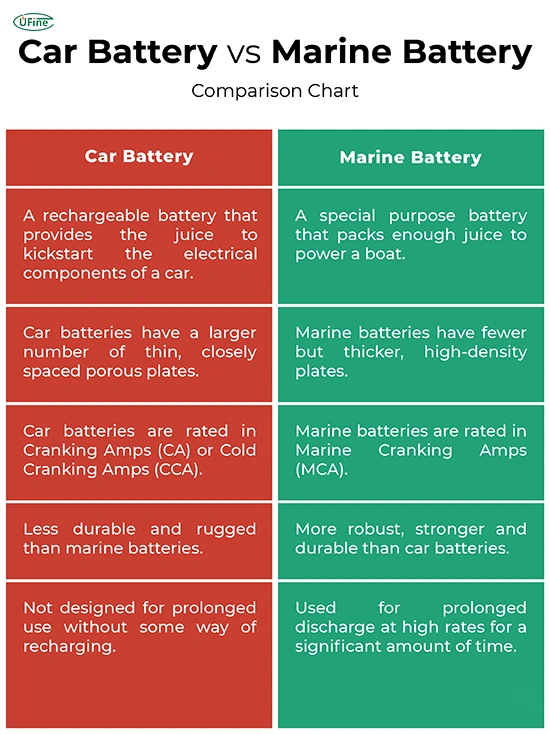
Image Source: www.ufinebattery.com
Fathoming Marine vs. Car Battery Designs
At first glance, a marine battery and a car battery might appear similar. Both are typically 12-volt lead-acid batteries designed to store and deliver electrical energy. However, their internal construction and intended purpose create significant distinctions that impact their suitability for different applications. The core difference lies in their primary function: starting versus deep cycling.
Car Batteries: The Sprint Specialists
Car batteries, also known as starting batteries or cranking batteries, are engineered for a very specific task: delivering a massive burst of power for a short duration. Think of it as a sprinter. When you turn the ignition key, the starter motor demands a high amperage current to spin the engine. Car batteries are built to handle this intense, short-term demand.
- Construction: They have a higher number of thin, lead plates. These plates provide a larger surface area, which is crucial for delivering that quick, powerful surge of electricity.
- Purpose: Their sole focus is to provide the cranking amps (CA) or cold cranking amps (CCA) needed to start the engine. Once the engine is running, the alternator takes over the electrical load and recharges the battery.
- Discharge: They are not designed for sustained, moderate discharge. Repeatedly draining a car battery beyond its intended capacity can significantly shorten its lifespan.
Marine Batteries: The Marathon Runners (and sometimes Sprinters)
Marine batteries are more versatile and, depending on the type, can be categorized into two main groups: starting batteries and deep cycle batteries.
-
Marine Starting Batteries: These are very similar to car batteries. They are designed to provide high cranking amps to start boat engines, which can often be larger and harder to turn over than car engines. If you’re asking about using a marine battery in a car and comparing it to a standard car battery, a marine starting battery is the closest match.
-
Marine Deep Cycle Batteries: This is where the significant difference lies. Marine deep cycle batteries are built for sustained power output over longer periods. Imagine a marathon runner. They need to provide a consistent flow of energy to power accessories like trolling motors, fish finders, bilge pumps, lights, and radios for extended durations without needing to be constantly recharged by an engine.
- Construction: Deep cycle batteries have thicker, more robust plates. This construction allows them to withstand repeated deep discharges and recharges without significant damage. Thicker plates mean less surface area compared to car batteries of the same size, which is why they generally have lower CCA ratings.
- Purpose: To provide a steady, reliable power source for electronic equipment and accessories on a boat over extended periods.
- Discharge: They are designed to be discharged to a much lower state of charge (often 50% or even 80%) repeatedly without detrimental effects.
Can I Use A Boat Battery In My Car? Deciphering the Possibilities
The question “Can I use a boat battery in my car?” hinges on the type of marine battery you are considering.
Using a Marine Starting Battery in a Car
If you have a marine starting battery, it’s more likely to be a viable substitute for a car battery, especially in a pinch. As mentioned, their design is similar, focusing on providing sufficient cranking amps to start an engine.
-
Pros:
- May offer similar CCA to a comparable car battery.
- Can provide the necessary jolt to start your car.
- Often built to withstand the vibrations and conditions found in vehicles.
-
Cons:
- May have a lower CCA rating than a dedicated car starting battery, potentially making starting in very cold weather more difficult.
- Might be physically larger or have different terminal configurations, requiring modifications.
- Generally more expensive than car batteries.
Using a Marine Deep Cycle Battery in a Car
This is where things become more problematic and generally inadvisable for daily driving.
-
Pros:
- Can technically start a car if its CCA rating is sufficient.
- Might last longer if you frequently use accessories with the engine off (though this is not typical car usage).
-
Cons:
- Lower CCA: The primary issue is that deep cycle batteries, even those labeled as “marine starting batteries” by some manufacturers, often have significantly lower CCA ratings than car starting batteries. This means they might struggle to crank your engine, especially in cold weather or if your engine is larger or has a slightly weaker starter.
- Weight and Size: Deep cycle batteries are typically heavier and bulkier due to their robust plate construction. This can make fitting them into a car’s battery tray difficult.
- Cost: They are generally more expensive than conventional car batteries.
- Not Optimized: They are not optimized for the high-amperage, short-duration bursts required by a car’s starter motor. Repeatedly demanding this kind of power can shorten the lifespan of a deep cycle battery, even though it’s designed for deep discharges.
- Overcharging Risk: While modern alternators have voltage regulators, a deep cycle battery may have different charging requirements or tolerances than a car battery. There’s a theoretical, albeit small, risk of overcharging or undercharging if the charging system isn’t perfectly matched.
Car Battery Replacement Marine: What to Look For
When considering a car battery replacement marine, the most critical factor is matching the marine battery specs car usage.
Key Marine Battery Specs for Car Compatibility
- Cold Cranking Amps (CCA): This is paramount. Your car’s owner’s manual will specify the minimum CCA required for reliable starting, especially in cold climates. You must ensure the marine battery you consider has a CCA rating that meets or exceeds your car’s requirements. A 12v marine battery car application needs to prioritize this number.
- Reserve Capacity (RC): This indicates how long the battery can deliver a certain amount of current (usually 25 amps) at 80°F (27°C) before its voltage drops below a usable level. While more important for deep cycle applications, a higher RC can be beneficial for powering accessories in your car when the engine is off.
- Terminal Type and Placement: Car batteries have specific terminal types (e.g., SAE posts) and locations. Ensure the marine battery’s terminals will connect properly and securely to your car’s battery cables.
- Physical Dimensions: Batteries come in various group sizes (e.g., Group 24, Group 35, Group 65). The marine battery must physically fit into your car’s battery tray and allow the hold-down clamp to secure it properly.
Marine Battery Pros and Cons for Car Use
| Feature | Marine Starting Battery in Car | Marine Deep Cycle Battery in Car |
|---|---|---|
| Primary Benefit | Can provide adequate starting power if CCA is sufficient. | Designed for sustained power, robust construction. |
| Starting Power | Generally comparable to car batteries. | Often lower CCA, may struggle to start in cold weather or with large engines. |
| Deep Discharge | Not designed for it; can be damaged by repeated deep drains. | Designed for it; can handle repeated partial discharges. |
| Lifespan in Car | Potentially similar to a car battery if used correctly. | May have a reduced lifespan if used for frequent starting or if consistently discharged deeply. |
| Cost | Often higher than comparable car batteries. | Typically higher than car batteries. |
| Weight/Size | Can vary, but some may be larger than car equivalents. | Usually heavier and bulkier. |
| Best Use Case | Emergency replacement if CCA is adequate. | Not recommended for typical car starting/driving. |
Battery Type Compatibility Car: The Crucial Factor
The fundamental issue when considering battery type compatibility car usage with a marine battery is the difference in engineering priorities.
- Car batteries are optimized for peak power delivery.
- Deep cycle marine batteries are optimized for sustained power delivery.
Trying to use a deep cycle marine battery as a direct replacement for a car battery is like using a drag racer to tow a heavy load – it’s not what it was built for, and while it might move the load, it’s inefficient and could cause damage.
Why a Deep Cycle Battery Isn’t Ideal for Your Car’s Starting Needs
- Lower Cranking Amps: As repeatedly emphasized, deep cycle batteries sacrifice cranking power for longevity in deep discharge scenarios. Your car’s starter motor needs a significant surge of amps. A deep cycle battery might simply not provide enough, leading to slow or no starts.
- Plate Structure: The thicker plates in a deep cycle battery offer less surface area for the chemical reaction that generates electrical current. This limits their ability to produce the massive, instantaneous current needed for starting.
- Weight Penalty: The robust construction that makes deep cycle batteries durable also makes them heavier. You’re carrying extra weight that doesn’t directly contribute to your car’s primary electrical needs.
- Cost-Effectiveness: You’ll likely pay more for a deep cycle battery than a comparable car battery, and you won’t be utilizing its unique deep-cycle capabilities in a typical car.
Can You Put A Marine Battery In A Car? The Practicalities
So, if you absolutely must, can you put a marine battery in a car?
The answer leans towards “yes, but…”
When It Might Be a Temporary Fix
- Emergency Situations: If your car battery dies unexpectedly and the only available replacement is a marine battery (ideally a marine starting battery with sufficient CCA), it could get you out of a bind. You’ll need to ensure it has the correct CCA rating and fits physically.
- Specific Vehicle Needs: Some older or specialized vehicles might have battery requirements that a readily available marine starting battery could meet. However, this is rare.
What to Check Before Installing a Marine Battery in Your Car
- CCA Rating: This is the absolute deal-breaker. Check your car’s manual or the old battery for the required CCA.
- Physical Fit: Measure the battery tray and the marine battery. Check terminal types and locations.
- Voltage: Ensure it’s a 12-volt battery. (Most are, but it’s worth confirming).
- Terminal Orientation: The positive and negative terminals must align with your car’s battery cables.
- Hold-Down Mechanism: The battery must be securely fastened.
The “Marine Battery Specs Car” Checklist
- CCA: Must meet or exceed car manufacturer’s minimum.
- Physical Size: Must fit battery tray and allow hold-down.
- Terminal Type/Location: Must match car’s cables.
- Voltage: Must be 12V.
- Weight: Consider if the extra weight is a significant issue.
Can I Use A Boat Battery In My Car? A Summary
Let’s break down the core considerations for using a boat battery in a car:
- Marine Starting Battery: Possible, provided it meets the CCA requirements and physical dimensions of your car. It’s essentially a car battery with a marine label and potentially a higher price tag.
- Marine Deep Cycle Battery: Not Recommended for general car use. While it might start your car if the CCA is adequate, it’s an inefficient and potentially damaging use of the battery. You’re paying for features you won’t use and not getting the optimal performance for your car’s needs.
Common Misconceptions and Considerations
Many people believe that because marine batteries are often built to be more robust and withstand harsher environments (like the constant vibration and moisture on a boat), they are inherently superior and thus a good upgrade for a car. While some marine batteries are robust, this robustness in deep cycle types comes at the expense of starting power, which is the car’s primary battery need.
Marine Battery vs. Car Battery: A Different Purpose
Think of it this way:
- Car Battery: A drag strip racer – designed for maximum acceleration over a short burst.
- Marine Deep Cycle Battery: A delivery truck – designed for consistent, sustained work over long periods.
- Marine Starting Battery: A street-legal sports car – good acceleration, but perhaps not the absolute peak of a dedicated drag car.
Using a delivery truck (deep cycle marine battery) to win a drag race (start your car) is a mismatch.
What if I have a High-CCA Marine Battery?
If you find a marine battery specifically marketed as a “high-CCA marine starting battery” and its CCA rating is sufficient for your vehicle, then it becomes a more plausible option. However, always scrutinize the specifications.
Replacing Your Car Battery: The Best Practice
When it’s time for a car battery replacement, it’s always best to opt for a battery specifically designed for automotive starting applications.
- Consult Your Owner’s Manual: This is the definitive source for your car’s battery requirements.
- Match CCA and Size: Choose a battery that meets or exceeds the CCA rating and fits the group size recommended by the manufacturer.
- Consider Your Climate: If you live in a cold climate, opt for a battery with a higher CCA rating than the minimum required.
- Reputable Brands: Purchase from reputable battery manufacturers and retailers to ensure quality and warranty support.
Conclusion: Marine Batteries and Cars – A Question of Fit
To circle back to the original question: Can you put a marine battery in a car?
The definitive answer is that it depends entirely on the type of marine battery and its specific marine battery specs car compatibility.
- A marine starting battery can work if its CCA and physical dimensions are appropriate.
- A marine deep cycle battery is generally not a good choice for a car’s starting needs due to its lower CCA and design optimized for sustained power rather than rapid, high-amperage bursts.
While you might be able to get your car started with a deep cycle marine battery in a pinch, it’s not a recommended long-term solution and could lead to starting problems or a shortened battery life. For reliable performance and to protect your vehicle’s electrical system, stick to automotive-specific starting batteries.
Frequently Asked Questions (FAQ)
Q1: Can I use any 12v marine battery in my car?
No, you cannot use any 12v marine battery in your car. The most critical factor is the Cold Cranking Amps (CCA) rating. Most marine batteries are deep cycle and have lower CCA than car starting batteries. You must ensure the marine battery meets or exceeds your car’s CCA requirements.
Q2: What’s the main difference between a marine battery and a car battery?
The main difference is their intended use. Car batteries are “starting” batteries, designed for a short, powerful burst of energy to crank the engine. Marine batteries come in two types: “starting” (similar to car batteries) and “deep cycle,” which are designed to provide a steady supply of power over a long period, like for trolling motors or electronics.
Q3: Will a deep cycle marine battery damage my car?
It’s unlikely to cause immediate catastrophic damage, but it’s not ideal. The primary concern is that a deep cycle battery may not have enough Cold Cranking Amps (CCA) to reliably start your car, especially in cold weather. Repeatedly trying to start with insufficient CCA can strain your starter motor. Additionally, using it for repeated deep discharges (which is what cars do during starting) can shorten its lifespan faster than intended.
Q4: Can I use a marine battery in my car as a temporary fix?
Yes, a marine starting battery with an adequate CCA rating can be used as a temporary fix in an emergency. However, a deep cycle marine battery is less reliable for this purpose due to lower CCA. Always aim to replace it with a proper automotive starting battery as soon as possible.
Q5: Are marine batteries better than car batteries?
“Better” depends on the application. Marine deep cycle batteries are better for powering electronics on a boat for extended periods. Marine starting batteries are designed to start engines and are comparable to car starting batteries. Car batteries are specifically designed for the high-demand, short-duration needs of starting a vehicle’s engine.
Q6: What happens if I use a marine battery with low CCA in my car?
If the CCA is too low, your car might struggle to start, especially in cold weather. You might hear a clicking sound or a slow cranking engine. Prolonged attempts could overheat and damage the starter motor.
Q7: Can I use a marine battery for my car’s accessories when the engine is off?
A deep cycle marine battery could do this better than a car battery because it’s designed for deep discharges. However, most cars are not designed to have their primary battery used extensively for accessories with the engine off, and you risk draining the battery and being unable to start the car.
Q8: How do I check if a marine battery’s CCA is enough for my car?
Check your car’s owner’s manual or the sticker on your current car battery for the recommended CCA rating. Then, look for the CCA rating on the marine battery’s label or specifications sheet. The marine battery’s CCA must meet or exceed your car’s requirement.
Q9: Are marine batteries more expensive than car batteries?
Generally, yes. Marine deep cycle batteries are typically more expensive than standard car starting batteries due to their specialized construction for deep discharge cycles and often higher durability standards for marine environments. Marine starting batteries might be similarly priced or slightly higher than comparable car batteries.
Q10: Will a marine battery fit in my car’s battery tray?
This varies greatly. Marine batteries come in many sizes, and some may not physically fit the battery tray or allow the hold-down clamp to secure them properly. Always measure and compare dimensions before attempting an installation.