

Have you ever listened to your favorite song and felt like something was missing? Maybe the bass isn’t deep enough, or the vocals sound a little muddy. That feeling is exactly why a graphic equalizer can be a game-changer for your home stereo system. It’s like having a magic wand to shape the sound, but with so many choices out there, picking the right one can feel overwhelming. You want to make your music sound its absolute best, but where do you even begin?
This guide is here to help you cut through the confusion. We’ll break down what a graphic equalizer actually does and why it’s a smart addition to your audio setup. You’ll learn what to look for when choosing one, from the number of bands to the types of connections. By the end, you’ll feel confident in finding an equalizer that will transform your listening experience, making every song sound richer, clearer, and more vibrant.
Our Top 5 Graphic Equalizer For Home Stereo Recommendations at a Glance
Top 5 Graphic Equalizer For Home Stereo Detailed Reviews
1. MIZISNR Stereo Graphic Equalizer 15-Band EQ for Home Audio System

Rating: 9.4/10
The MIZISNR Stereo Graphic Equalizer EQX-215S is a powerful tool for anyone looking to fine-tune their home audio system or professional DJ setup. This dual-channel equalizer gives you precise control over your sound, making it easier to achieve that perfect listening experience.
What We Like:
- It offers professional-grade dual-channel stereo graphic equalization, perfect for audiophiles and pros.
- You get 15 bands of control on each channel, with an adjustable range of ±12dB for each band.
- You can easily adjust gain and decay values from ±6dB to ±12dB for unmatched sound shaping.
- The Low-Cut feature lets you remove unwanted low-end noise by adjusting the frequency with a knob.
- It has a simple EQ switch for normal and bypass modes, making it easy to use.
- The 1U rack-mount design fits easily into your setup.
- It connects with XLR balanced and 1/4″ TRS unbalanced options for great flexibility.
- A dedicated subwoofer output with adjustable frequency gives you control over the bass.
- You get 24/7 support, with a promise of a solution within 24 hours.
What Could Be Improved:
- While powerful, the extensive controls might be a bit overwhelming for absolute beginners.
- The manual, though helpful, could be more visually detailed for easier understanding of advanced features.
This equalizer brings professional sound control to your fingertips. It’s a solid choice for anyone serious about their audio quality.
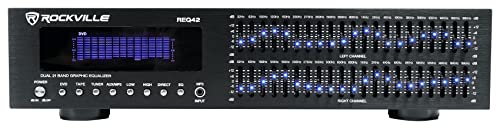
2. Rockville REQ42-B Dual 21-Band Graphic Equalizer
Rating: 8.7/10
The Rockville REQ42-B Dual 21-Band Graphic Equalizer is a powerful tool for shaping your sound. This equalizer gives you lots of control over your audio. You can use it in your home studio or for live shows. It has two separate 21-band equalizers. This means you can adjust a wide range of frequencies from 20Hz to 20kHz. It also comes with RCA inputs and outputs. This makes it easy to connect your gear. There’s even a 3.5mm jack for your MP3 player or phone.
What We Like:
- It offers dual 21-band EQ for detailed sound control.
- Easy to connect with RCA and a 3.5mm MP3 input.
- It’s ready for your rack, fitting standard 19″ setups.
- Blue LED sliders and VU meters help you see your levels clearly.
- The build is tough, and it’s not too heavy.
- It’s a great value for the features it offers.
What Could Be Improved:
- The user manual could be more detailed for beginners.
- While the build is robust, some might prefer more premium materials.
This equalizer provides excellent sound shaping capabilities for its price. It’s a solid choice for anyone looking to fine-tune their audio setup.
3. Stereo Graphic EQ8000

Rating: 9.5/10
The Stereo Graphic EQ8000 is a powerful 31-band graphic equalizer designed for serious audio enthusiasts and professionals. It offers a wide range of connectivity options and advanced features to fine-tune your sound, making it suitable for everything from home theaters to live concerts.
What We Like:
- It acts as a central hub for all your audio devices, connecting easily with optical, coaxial, and USB.
- The 31 bands of equalization give you precise control over your sound, helping to eliminate feedback and noise.
- Its design is both tough for touring and slim for studio racks.
- The LED display and color-coded buttons make it easy to adjust settings quickly.
- It’s versatile, working well for car audio, home theaters, DJs, and live stages.
- Bluetooth 5.4 is included for wireless streaming.
- Noise reduction technology cleans up your audio.
What Could Be Improved:
- The 12 customizable jump modes and dual 10-segment EQ slivers might be a bit complex for beginners.
- While portable, it’s still a piece of equipment that requires careful handling.
The EQ8000 is a fantastic tool for anyone seeking to elevate their audio experience with professional-grade control and clarity.
4. MIZISNR Graphic Equalizer 31-Band Stereo EQ for Home Audio

Rating: 9.3/10
The MIZISNR Graphic Equalizer EQ-231 is a powerful tool for anyone who wants to fine-tune their audio. It’s a dual-channel stereo graphic equalizer, meaning it has separate controls for left and right audio channels. This professional-grade equalizer helps you get the best sound possible, whether you’re listening at home or working in a studio.
What We Like:
- It has 31 bands per channel, giving you lots of control over your sound.
- You can adjust each band by +/-12dB, and even change gain and decay from +/-6dB to +/-12dB for super precise adjustments.
- The LOW-CUT switch is great for getting rid of unwanted low-frequency noise like wind or electrical hum, resulting in cleaner sound.
- A BYPASS switch makes it easy to compare your EQ settings, making setup and testing simpler.
- It has versatile input and output options, including XLR and 1/4″ TRS, so it works with many different audio devices.
- The 4-segment LED ladders provide clear visual feedback on gain reduction and output levels.
What Could Be Improved:
- For home users, the sheer number of controls might feel a bit overwhelming at first.
- While it’s professional-grade, the price point might be a bit high for casual listeners.
This equalizer offers excellent sound shaping capabilities for both home and professional use. It’s a solid choice for anyone serious about achieving optimal audio clarity and control.
5. MICNAUX Equalizer for Home Stereo Audio System

Rating: 8.8/10
The MICNAUX 31-Band Graphic Equalizer is a powerful tool for anyone who wants to fine-tune their home stereo or studio sound. It offers precise control over every part of your audio, making your music sound exactly how you want it. This digital EQ is designed for both professional use and home enthusiasts who care about great sound.
What We Like:
- It has a 31-band graphic equalizer, which gives you super detailed control over your sound.
- The LED spectrum display shows you exactly what frequencies are changing, making adjustments easy, especially in dim light.
- You can save up to 10 custom sound settings, so you can quickly switch between different listening styles.
- Intelligent noise reduction helps clean up your audio for a clearer listening experience.
- Bluetooth 5.2 makes it simple to stream music wirelessly from your phone or tablet.
- It also plays music from a USB drive, supporting high-quality audio files.
- A dedicated subwoofer output lets you boost the bass exactly how you like it.
- The bypass switch lets you quickly turn the EQ effects on and off.
- It fits easily into a standard 1U rack for a tidy setup.
- It connects to almost any audio gear with XLR and 1/4″ TRS ports.
What Could Be Improved:
- The manual might be a bit complex for absolute beginners.
- While it has noise reduction, very extreme EQ settings might still introduce some subtle artifacts.
This equalizer offers fantastic control and flexibility for any audio setup. It’s a solid choice for improving your sound quality significantly.
Finding Your Perfect Sound: A Graphic Equalizer Buying Guide for Home Stereo
What is a Graphic Equalizer?
A graphic equalizer is a cool tool that lets you tweak the sound of your home stereo. Think of it like a sound sculptor. It has sliders or knobs that control different parts of the sound’s pitch, from deep bass to high treble. You can boost or cut these frequencies to make your music sound exactly how you like it.
Key Features to Look For
Number of Bands
The number of “bands” on an equalizer tells you how many sliders or controls it has. More bands mean you have finer control over the sound. For a home stereo, 10 to 15 bands per channel is usually a good starting point. If you want to really fine-tune your audio, look for 31 bands. This gives you lots of options.
Connectivity Options
Make sure the equalizer can connect to your stereo system. Common connections include RCA (red and white plugs) and sometimes XLR for higher-end setups. Check the input and output types to ensure they match your amplifier or receiver.
Bypass Function
A bypass button is important. It lets you easily switch between the equalizer’s effect and the original sound. This helps you compare and decide if you like the changes you’ve made.
Build Quality and Materials
A well-built equalizer will last longer and perform better. Look for solid metal casings instead of plastic. Metal helps reduce electrical interference, which can make your sound cleaner. The sliders should feel smooth and sturdy, not loose or wobbly.
Factors That Improve or Reduce Quality
Signal-to-Noise Ratio (SNR)
This measures how much unwanted noise the equalizer adds to your audio. A higher SNR means less noise and clearer sound. Aim for an SNR of 90 dB or higher.
Harmonic Distortion
This is unwanted extra sound that gets added to the original audio. Lower distortion levels mean a more accurate and natural sound. Look for very low Total Harmonic Distortion (THD) percentages, usually less than 0.05%.
Power Supply
A clean and stable power supply is crucial. Some equalizers have external power bricks, which can help keep electrical noise away from the audio circuits. Internal power supplies should be well-designed to avoid introducing hum or buzz.
User Experience and Use Cases
Adjusting for Room Acoustics
Every room sounds different. A graphic equalizer helps you compensate for how your room affects the sound. You can boost frequencies that sound weak or cut those that are too loud. This makes your music sound more balanced in your listening space.
Tailoring Sound to Your Preferences
Some people like more bass. Others prefer clearer vocals. An equalizer lets you customize the sound to your exact taste. You can make rock music punchier or classical music more delicate.
Fixing Poorly Recorded Music
Sometimes, music isn’t recorded perfectly. An equalizer can help fix some of these issues. You might be able to reduce harshness or add warmth to a recording that sounds a bit flat.
Connecting Different Audio Sources
If you have multiple audio sources, like a turntable and a CD player, an equalizer can help ensure they all sound their best through your stereo.
Frequently Asked Questions (FAQ)
Q: Do I really need a graphic equalizer for my home stereo?
A: It depends on your goals. If you’re happy with how your stereo sounds, you might not need one. But if you want more control or want to improve the sound in your specific room, an equalizer can be very helpful.
Q: Will a graphic equalizer make my speakers sound better?
A: It won’t magically make bad speakers sound amazing, but it can help you get the best possible sound out of your existing speakers. It adjusts the audio *before* it reaches your speakers.
Q: How many bands are enough for a home stereo?
A: For most people, 10-15 bands per channel offer good control. If you’re an audiophile who loves detailed adjustments, 31 bands might be worth considering.
Q: What’s the difference between a graphic equalizer and a parametric equalizer?
A: A graphic equalizer has fixed frequency bands you can adjust. A parametric equalizer gives you more control over the width and center frequency of each adjustment, offering even finer tuning.
Q: Can I use a graphic equalizer with a soundbar?
A: Some soundbars have built-in EQ functions. If yours doesn’t, you might be able to connect an external graphic equalizer if the soundbar has the right audio inputs and outputs.
Q: Is it hard to set up a graphic equalizer?
A: No, setup is usually straightforward. You connect it between your audio source (like a CD player) and your amplifier or receiver. The user manual will guide you through the connections.
Q: What does “boosting” and “cutting” frequencies mean?
A: Boosting means increasing the volume of a specific sound range (like bass). Cutting means decreasing the volume of that range.
Q: Can a graphic equalizer fix distorted audio?
A: It can help reduce some types of distortion, especially if the distortion is caused by your room’s acoustics. However, it can’t fix distortion that’s already in the music recording itself.
Q: Are there any digital graphic equalizers for home stereos?
A: Yes, many modern AV receivers and some digital audio players have built-in digital equalizers. There are also standalone digital processors available.
Q: Where should I place the sliders when I first set it up?
A: A good starting point is to set all sliders to the center position (0 dB). Then, listen to your music and make small adjustments to frequencies that sound too loud or too quiet.
In conclusion, every product has unique features and benefits. We hope this review helps you decide if it meets your needs. An informed choice ensures the best experience.
If you have any questions or feedback, please share them in the comments. Your input helps everyone. Thank you for reading.